Behavior of the affectation percentage for the coffee berry borer during the humid benefit process
Article Sidebar
Main Article Content
Abstract
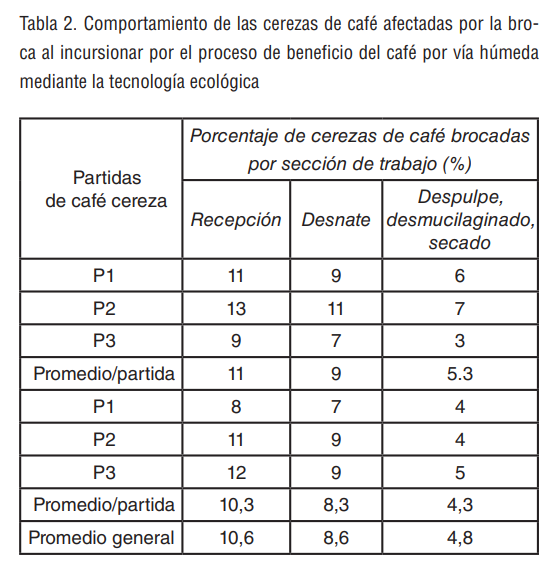
The work was developed respectively in the pulping center File, Matías and Comecará belonging to Tercer Frente municipality, as well as in entities of the base productive tax-payers to these centers of benefit, located in Santiago de Cuba province. Its execution took place in the period understood among 2008 at the 2009 years, the evaluations were carried out in cherry samples of Coffea arabica Lin that were processed by means of the technologies of benefit traditional and the ecological benefit technology to which were determined the percentage of coffee affected by the drill of the coffee in each work section in that intrude the cherries of coffee during the process of benefit for humid way (Reception of the brown cherry, Skim of cherries of coffee in the event of the ecological benefit, pulping center of cherry of coffee, Fermentation or Demucilage of brown parchment according to the case, laundry and skim of the brown parchment and drying of the brown parchment). It is appreciated that the brown cherry affected by the drill from the coffee when intruding for the technology of traditional benefit reduces the percentage of affectation in 64 % while when being processed by the ecological technology the reduction it is of 55 % showing the best results the technology of traditional benefit.
Article Details

This work is licensed under a Creative Commons Attribution-NonCommercial 4.0 International License.
Those authors who have publications with this journal accept the following terms of the License Attribution-NonCommercial 4.0 International (CC BY-NC 4.0):
You are free to:
- Share — copy and redistribute the material in any medium or format
- Adapt — remix, transform, and build upon the material
The licensor cannot revoke these freedoms as long as you follow the license terms.
Under the following terms:
- Attribution — You must give appropriate credit, provide a link to the license, and indicate if changes were made. You may do so in any reasonable manner, but not in any way that suggests the licensor endorses you or your use.
- NonCommercial — You may not use the material for commercial purposes.
- No additional restrictions — You may not apply legal terms or technological measures that legally restrict others from doing anything the license permits.
The journal is not responsible for the opinions and concepts expressed in the works, they are the sole responsibility of the authors. The Editor, with the assistance of the Editorial Committee, reserves the right to suggest or request advisable or necessary modifications. They are accepted to publish original scientific papers, research results of interest that have not been published or sent to another journal for the same purpose.
The mention of trademarks of equipment, instruments or specific materials is for identification purposes, and there is no promotional commitment in relation to them, neither by the authors nor by the publisher.
How to Cite
References
Decazy, B. y M. T. Castro: El manejo integrado de la broca del fruto del cafeto (Hypothenemus hampei). Manual técnico. Guatemala C.A: IICA/PROMECAFE, 20 Pp., 1990.
Federación Nacional de Cafeteros de Colombia: La broca del café. División Sanidad Vegetal. Boletín de Extensión Nº 57, 18 Pp., 1989.
González, G.; Posada, M. T. y F. G. Bastillop: Desarrollo de un bioensayo para evaluar la patogenicidad de la Beauvaria bassiana sobre Hypothenemus hampei. CENICAFE, 44(3): 93.-102, 1993.
Jiménez, C. M.: Patogenicidad de diferentes aislamientos de Beauveria bassiana a la broca del café. CENICAFE 43 (3): 84-98, 1992.
Murphy, S. T. and D., Woke: Biological control of the coffee berry borer (Hypothenemus hampei Ferrari); (Coleoptera: Scolytidae), previanes programme and possibilities for the future. Biocontrol news and information 11(2): 107-117, 1990.
Reid, J. C.: Distribution of the coffee berry borer (Hypothenemus hampei F.), within Jamaica. Following itis discovery in 1978, Tropical Pest Management 29: 224-230, 1983.
Rena, A. B.; Nacif, A. P. e A. A. Pereira: Fisiología do cafeeiro em plantíos adensados. En: Simposio Internacional sobre Café Adensado, Londrina, Brasil. Resumos. Londrina. IAPAR, p.14., 1994.
Souza, J. C. e P. R. Reis: Broca do café: histórico, reconhecimento, biología, prejuizos, Monitoramento e controle. Belo Horizonte. Brasil. EPAMIG, Boletín Técnico, Nº 40. 28 Pp., 1993.
Villacorta, A.: Manejo Integrado de la broca del café. En: Resúmenes del Simposio Internacional de Café y Cacao. Santiago de Cuba, Pp.29-32, 1999.
Vergara, O. J. D.; Orozco, J.; Bustillo, A. E. y B. Chávez: Biología de Phymastichus coffea en condiciones de campo. CENICAFE, 52(2): 97-103, 2001.
Zucchi, R. A.; Siveira Neto, S. y Nakano, O.Guía de Identificação de Pragas. 1993.