Cocoa fermentation in pulp into pylons above wooden platform under ceiling
Article Sidebar
Main Article Content
Abstract
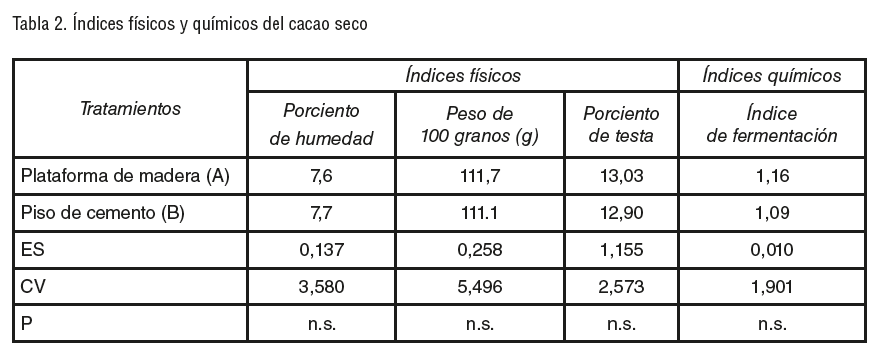
The investigation was carried out in the Estación Experimental Agroforestal Baracoa and the Center of Benefit of Jamal belonging to the Company of Coffee and Cocoa of Baracoa, in the Guantánamo province from October of 2004 until May of 2007 with the purpose of comparing the results of the process of fermentation of the cocoa in pulp in pylons above wooden platform under ceiling and above cement floor. To the dry cocoa was determined: the court test, physical indexes (head %, weight of 100 grains and % of humidity) and chemical (index of fermentation). The data were processed by means of a variance analysis of simple classification. In spite of being obtained a product of first quality in both variants, in the fermentation of the cocoa in pulp in pylons above roofed wooden platform 13% of defects total it was achieved, the physical indexes and chemists had lightly superior values, the grain didn’t stain, the risk didn’t run of being wet in rainy times, the grains were not affected that they were in the superficial layer in contact with the polyethylene blankets for the direct incidence of the sunbeams and was carried out the turn in rainy periods.
Article Details

This work is licensed under a Creative Commons Attribution-NonCommercial 4.0 International License.
Those authors who have publications with this journal accept the following terms of the License Attribution-NonCommercial 4.0 International (CC BY-NC 4.0):
You are free to:
- Share — copy and redistribute the material in any medium or format
- Adapt — remix, transform, and build upon the material
The licensor cannot revoke these freedoms as long as you follow the license terms.
Under the following terms:
- Attribution — You must give appropriate credit, provide a link to the license, and indicate if changes were made. You may do so in any reasonable manner, but not in any way that suggests the licensor endorses you or your use.
- NonCommercial — You may not use the material for commercial purposes.
- No additional restrictions — You may not apply legal terms or technological measures that legally restrict others from doing anything the license permits.
The journal is not responsible for the opinions and concepts expressed in the works, they are the sole responsibility of the authors. The Editor, with the assistance of the Editorial Committee, reserves the right to suggest or request advisable or necessary modifications. They are accepted to publish original scientific papers, research results of interest that have not been published or sent to another journal for the same purpose.
The mention of trademarks of equipment, instruments or specific materials is for identification purposes, and there is no promotional commitment in relation to them, neither by the authors nor by the publisher.
How to Cite
References
Barel, M.: Traitment du cacau par fermenteur et sechoir integrés. Plantations, recherche development, Sept. - Oct., pp. 35-40, 1995.
Braudeau, J.: El Cacao. Ciencia y Técnica. La Habana. pp. 189 –205. 1970.
Cros, E.; Roully, M.; Villanueve, F. y J. C. Vincent: Investigación de un índice de fermentación del cacao. II. Estimación de la materia colorante roja en los granos de cacao. Café, Cacao Thé 26(2): 115-122, 1982.
Márquez, J. y María Beatriz Aguirre: Manual técnico de cosecha y beneficio del cacao. 1 ed. Ciudad de La Habana, pp. 25-30. 2003.
Melo, G. R. y M. Pereira: Factores genéticos relacionados con la calidad del cacao. En: Informe de pesquisas. Bahia, Brazil, p. 24. 1986.
MINAG, Ministerio de la Agricultura, Cuba: Instrucciones Técnicas para la cosecha y el beneficio del café y cacao. – La Habana: CIDA, 208 pp., 1987.
Norma Cubana: Cacao en grano. Determinación del contenido de humedad. NC-ISO 2291, pp. 4 – 6. 2006.
Norma Cubana: Determinación del peso de 100 granos de cacao. NC 87-05-06, pp. 3-4. 1982.
Norma Cubana: Cacao en grano. Prueba de corte. NC-ISO 1114, p. 4. 2006.
Norma Cubana. Cacao Beneficiado. Especificaciones, pp. 4-6. 1998.
Nosti, J.: Café y Cacao: Ed. Revolucionaria. La Habana, pp. 305-332. 1970.
Oliveros, A.; Lambertt, W.; Menéndez, M.; Nariño, A. y A. Columbié: Utilización de diferentas especies maderables para la construcción de cajas para la fermentación del cacao. Café Cacao 3 (1): 70-72, 2002.
Pérez, P.; Toirac, E. P.; Lambertt, W. y F. Selva: Incremento de las capacidades fermentativas en las plantas de beneficio al aumentar el volumen de las cajas. Café Cacao 2 (2): 57-60, 2001.
Rohan, T. H.: El beneficio del cacao bruto destinado al mercado. FAO. Roma, pp. 35-121. 1964.
Sneder, G. W. y W. D. Cochran: Métodos estadísticos. -México: Continental S.A., pp. 683-685, 1977.
Urquhart, D. H.: Cacao: Ed. Revolucionaria. La Habana, pp. 137174. 1963.
Vincent, J. C.: Posibilidad de mejorar la calidad del cacao y de racionalizar la producción en los países productores. En: Memorias de la Quinta reunión del grupo asesor de la economía cacaotera mundial. Londres, Inglaterra, p. 21. 1988.