In vitro callus test of selected genotypes of Coffea arabica L. for evaluating the susceptibility to anthracnose
Article Sidebar
Main Article Content
Abstract
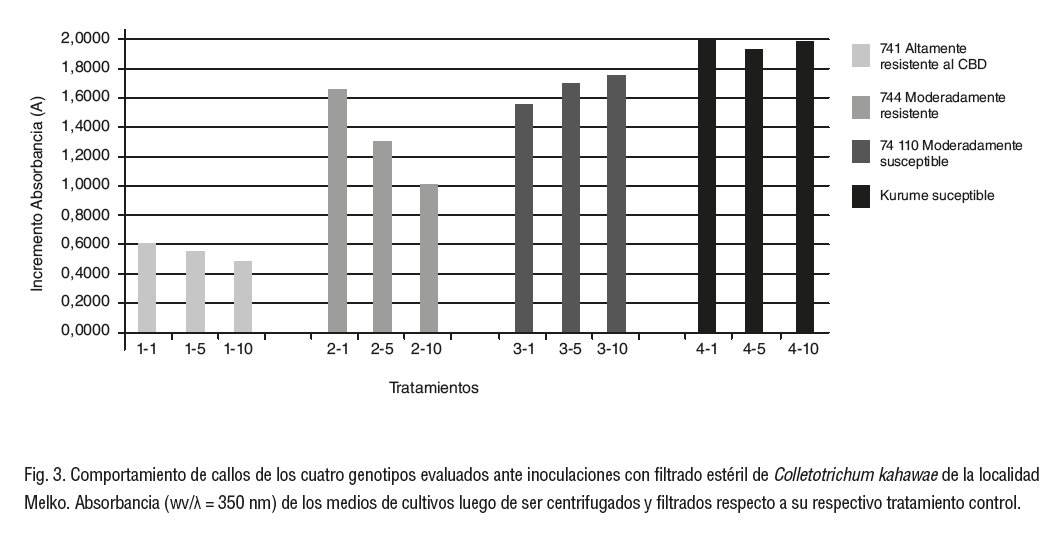
The antracnose of the coffees is caused mainly by mushrooms of the gender Colletotrichoum that produce deep lesions and very defined on the areas of the attacked plants, they are responsible for destructions in the fruits, branches and leaves, frequently they cause lethal destructions for the plantations. The objective of this work is to evaluate In Vitro the effect of a partially purified filtrate of the patógeno Colletotrichum kahawae it has more than enough tripes of 4 selections of coffee (741 Highly resistant to the CBD, 744 Moderately resistant to the CBD, 74110 Susceptible to the CBD and Susceptible Kurume to the CBD). Two isolated of C. kahawae (Gera and Melko) obtained in the laboratory of fitopatología of JARC they were used. The fitotoxicidad of the filtrate was proven in leaves and hipocótilos of coffee. Several concentrations of the watery extract were applied (1, 5 and 10 % v/v in 50 mL of half of cultivation). Means of cultivations of tripes without watery extract were used as control. Was the cabios of coloration observed in tripes and half of cultivation liquidate and was the absorbancia measured to wv/λ = 350 nm after the centrifugación. Very defined answer, characterized with presence of superficial lesions in form of small depressions (chancres) of brown and black color they were obtained in hipocótilos of susceptible coffees when they were inoculated with the sterile extract. Tripes of creamy white color were obtained independently to the 8 weeks of cultivation of the genotipo of evaluated coffee. The sterile filtrates of Colletotrichum kahawae (Gera and Melko) they produced increment in the Absorbancia of the means of cultivation liquid of the tripes of all the evaluated germoplasmas of coffee compared with the witness. Situation waited in the design of the experiment because the absorbancia in the means increases in the measure that the concentration of substances that the coloration and the metabolic activity that it is stimulated with the use of substances elicitoras take place increases like they are the watery extracts of microorganisms patógenos. Tripes of the resistant genotipos responded different to those of susceptible genotipos as for coloration, when applying the sterile filtered extract of Colletotrichum kahawae. I model that can be used to differentiate susceptible genotipos of resistant to antracnose.
Article Details

This work is licensed under a Creative Commons Attribution-NonCommercial 4.0 International License.
Those authors who have publications with this journal accept the following terms of the License Attribution-NonCommercial 4.0 International (CC BY-NC 4.0):
You are free to:
- Share — copy and redistribute the material in any medium or format
- Adapt — remix, transform, and build upon the material
The licensor cannot revoke these freedoms as long as you follow the license terms.
Under the following terms:
- Attribution — You must give appropriate credit, provide a link to the license, and indicate if changes were made. You may do so in any reasonable manner, but not in any way that suggests the licensor endorses you or your use.
- NonCommercial — You may not use the material for commercial purposes.
- No additional restrictions — You may not apply legal terms or technological measures that legally restrict others from doing anything the license permits.
The journal is not responsible for the opinions and concepts expressed in the works, they are the sole responsibility of the authors. The Editor, with the assistance of the Editorial Committee, reserves the right to suggest or request advisable or necessary modifications. They are accepted to publish original scientific papers, research results of interest that have not been published or sent to another journal for the same purpose.
The mention of trademarks of equipment, instruments or specific materials is for identification purposes, and there is no promotional commitment in relation to them, neither by the authors nor by the publisher.
How to Cite
References
Abdelwahd, R; Hakam, N; Labhilili, M. and S. UduPa: Use of an adsorbent and antioxidants to reduce the effects of leached phenolics in in vitro plantl et regeneration of faba bean. African Journal of Biotechnology 7: 997-1002, 2008
Arega, Zeru: “Diversity of Arabica Coffee Population in Afromontane Rain Forests of Ethiopia in relation to Colletotrichum kahawae and Gibberella xilarioides” [inédito], tesis de candidatura. Addis Ababa University. 2006.
Azofeifa, Álvaro: Problemas de oxidación y oscurecimiento de explantes cultivados in vitro. Agronomía Mesoamericana 20(1): 153-175, 2009.
Biratu, T.: “Studies on Colletotrichum population of Coffea arabica L. in Ethiopia and evaluation of the reactions of coffee germplasms” [inédito], tesis de candidatura. University of Bonn, Germany. 1995.
Biratu, T.: Effects of caffeine on coffee berry disease (Colletotrichum kahawae). ASIC 17:727-733, 1997.
De García, Eva G. y Margarita Rafael: Propagación clonal de plantas de café (Coffea arabica L. ‘Catimor’) a partir de microesquejes cultivados in vitro* Universidad Central de Venezuela Facultad de Ciencias. Centro de Botánica Tropical. Apdo. 47114. Caracas 1041. Venezuela. 1989. Isaac Alemán, Elizabeth; Mbogholi, Andrew; González-Olmedo, Justo; Yilan Fung Boix; Azanza, Guillermo y Carlos Aragón: Evaluación de la actividad del superóxido dismutasa en plantas in vitro de cafeto bajo un campo electromagnético. En: IX SIMPOSIO INTERNACIONAL DE BIOTECNOLOGÍA VEGETAL 20 - 22 de abril de 2010. IBP, Cuba. 2010.
Orozco, S.; F.; Hoyos S., R. y M. Arias Z.: Cultivo de células vegetales en biorreactores: un sistema potencial para la producción de metabolitos secundarios Rev. Fac. Nal. Agr. Medellín 55, (1):1473-1495, 2002.
Plant Pathology Department (PPD): Antracnose. Florida Cooperative Extension Service, Institute of Food and Agricultural Sciences, University of Florida. Original publication date June 1994. Reviewed April 2003. Visit the EDIS Web Site at http://edis.ifas.ufl.edu. Pp. 136, 2003.
Pompeu, G.; Gratão, P.; Vitorello, V. y R. Azevedo: Antioxidant isoemzyme responses to nickel-induced stress in tabacco cell suspension culture. Ciencia Agricola 65: 548-552, 2008.
Quirós, Y.; Quiñones, J.; Trujillo, R.; Augustine, T.; Capdesuñer, Y.; Borroto, J. y M. Hernández: Contenido de fenoles en callos provenientes de hojas de Theobroma cacao L. En: IX SIMPOSIO INTERNACIONAL DE BIOTECNOLOGÍA VEGETAL 20 - 22 de abril de 2010. IBP, Cuba. 2010.
Rojas, Luis; Portal, Orelvis y Elio Jiménez: Extracción de ARN total en plantas y hongos filamentosos. Biotecnología Vegetal 11(4): 213 – 222, 2011.
Sánchez-García, Cynthia; Yelenys Alvarado-Capó, Mayra Acosta-Suárez, Mileidy Cruz-Martín; Leiva-Mora, Michel y Berkys Roque: Respuesta histoquímica defensiva en plantas de dos genotipos de Musa spp. Inoculados artificialmente con M. fijiensis. En: IX SIMPOSIO INTERNACIONAL DE BIOTECNOLOGÍA VEGETAL 20 - 22 de abril de 2010. IBP, Cuba. 2010.
Shao, H. B.; Chu, L. Y.; Shao, M. y A. Cheruth: Higher plant antioxidants and redox signaling under environmental stresses. c.r. Biologies 331:433-441, 2008.