Productive results Theobroma cacao L. In the area of Jibacoa
Article Sidebar
Main Article Content
Abstract
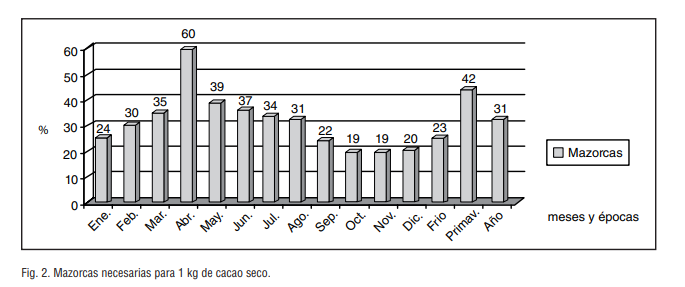
It offers the results of the evaluations at a hybrid population of Theobroma cocoa L. developed at the Agroforestal Experimental Station located at Jibacoa in the Villa Clara´s Mountains (Escambray), from September 2010 to August 2012. The research was carried out with the objective of evaluating the productive results of the cocoa, under the conditions of Jibacoa´s weather and soil, in the central region of Cuba. In the study the productivity of cocoa was counted, the index of cob to obtain a kilogram of dry cocoa was measured as well as the temperatures and rain rates. The production of the plantation was of 6822 cobs, and after dried, 222.71 kg were obtained. The biggest cob harvest was gathered in spring (February to August) with 56.4 % of the total harvest. However the biggest production of dry cocoa registered during the winter harvest (September to February) with 59.3 %. The decisive factors in the results were rain and temperature. The climatic conditions in Jibacoa favored the emission of fruits of Theobroma cocoa L. and the production of dry cocoa was affected during the spring harvest by the drought and the low temperatures. As a result, a larger number of cobs were needed to obtain 1 kg of dry bean, being low the productivity.
Article Details

This work is licensed under a Creative Commons Attribution-NonCommercial 4.0 International License.
Those authors who have publications with this journal accept the following terms of the License Attribution-NonCommercial 4.0 International (CC BY-NC 4.0):
You are free to:
- Share — copy and redistribute the material in any medium or format
- Adapt — remix, transform, and build upon the material
The licensor cannot revoke these freedoms as long as you follow the license terms.
Under the following terms:
- Attribution — You must give appropriate credit, provide a link to the license, and indicate if changes were made. You may do so in any reasonable manner, but not in any way that suggests the licensor endorses you or your use.
- NonCommercial — You may not use the material for commercial purposes.
- No additional restrictions — You may not apply legal terms or technological measures that legally restrict others from doing anything the license permits.
The journal is not responsible for the opinions and concepts expressed in the works, they are the sole responsibility of the authors. The Editor, with the assistance of the Editorial Committee, reserves the right to suggest or request advisable or necessary modifications. They are accepted to publish original scientific papers, research results of interest that have not been published or sent to another journal for the same purpose.
The mention of trademarks of equipment, instruments or specific materials is for identification purposes, and there is no promotional commitment in relation to them, neither by the authors nor by the publisher.
How to Cite
References
Columbié, A.; P. Pérez; A. Nariño; M. Menéndez; A. Oliveros; W. Lambertt y G. Matosl. Comportamiento Mensual de la Producción Cacaotera en el Municipio de Baracoa. Café y Cacao, 3(1):93-94, 2002.
Cuba-MINAGRI. Instrucciones técnicas para el cultivo y cosecha de café y cacao, CIDA, Ciudad de la Habana. 176 p., 1987.
González, F. Ecofisiología del Cacao. En: http://diplomado2007unas.blogspot.com/2008/01/ecofisiologia-del-cacao. html [Consulta: enero, 15 2013], 2008.
González, C. Efectos de la combinación de dolomita y materia orgánica en la producción de posturas de café. Tesis en opción al grado de Máster en Ciencias Agrícolas. Universidad de Cienfuegos “Carlos Rafael Rodríguez”. 22 p., 2009.
Hartmann, M y J. Larramendi. Cuna del Cacao de Cuba. Stockmans Publishing. 247 p., 2011.
Hernández, A.; A. Cabrera; M. Ascanio; Marisol Morales; L. Rivero; N. Martin; J. Baisre y E. Frómeta. Nueva Versión de Clasificación de los Suelos de Cuba. Instituto de Suelos. Ministerio de la Agricultura. Ciudad Habana. CUBA. 64 p., 1999.
Hernández, J. Fitotecnia del Cacao. Ciudad Habana. CUBA. 230 p., 1983.
Márquez, J. Cacao Noti Cortas. CUBA. 80 p., 2003.
Márquez, J. y María Beatriz Aguirre. Manual Técnico de Cosecha y Beneficio del Cacao. Ciudad Habana. CUBA. 59 p., 2003.
Márquez, J. y María Beatriz Aguirre. Manual Técnico de Manejo Agrotécnico de las Plantaciones del Cacao. CUBA. 80 p., 2008.
Menéndez, M.; Lambertt W.; Columbié A.; Matos G.; Oliveros A.; Miriam Rodríguez; y E. Sánchez. Selección de Clones de Theobroma cacao Lin. con Alto Potencial Productivo y de Calidad Industrial. Café y Cacao, 3(1): 64-66, 2002.
Nariño, A.; M. Menéndez; G. Matos; A. Columbié; W. Lambertt; F. Selva; A. Oliveiros y E. Sánchez. Producción Intensiva de Cacao a Bajo Costo. Café y Cacao, 3(1): 74-76, 2002.
Ramos, C. G.; Gómez, A.; La Cruz, C. y Azocar, A. Evaluación de una plantación de cacao Criollo Guasare. Relación entre la producción y parámetros de vigor. Agronomía Tropical, 15(2): 175-186, 2001.
Sánchez L.; Dercy Parra; Gamboa E. y J. Rincón. Rendimiento de una Plantación Comercial de Cacao ante Diferentes Dosis de Fertilización con NPK en el Sureste del Estado Táchira, Venezuela. Bioagro, 17(2): 119-122, 2005.
Vieira, J.; E. Varejão; G. Andrade; R. Valle; M. Nunes y P. Lima. Comportamento Productivo de Cacau no Semiárido do Brasil. Agrotrópica, 24(2):85-90, 2012.