Micronutrient diagnosis in coffee plantations in the province of Santiago de Cuba
Article Sidebar
Main Article Content
Abstract
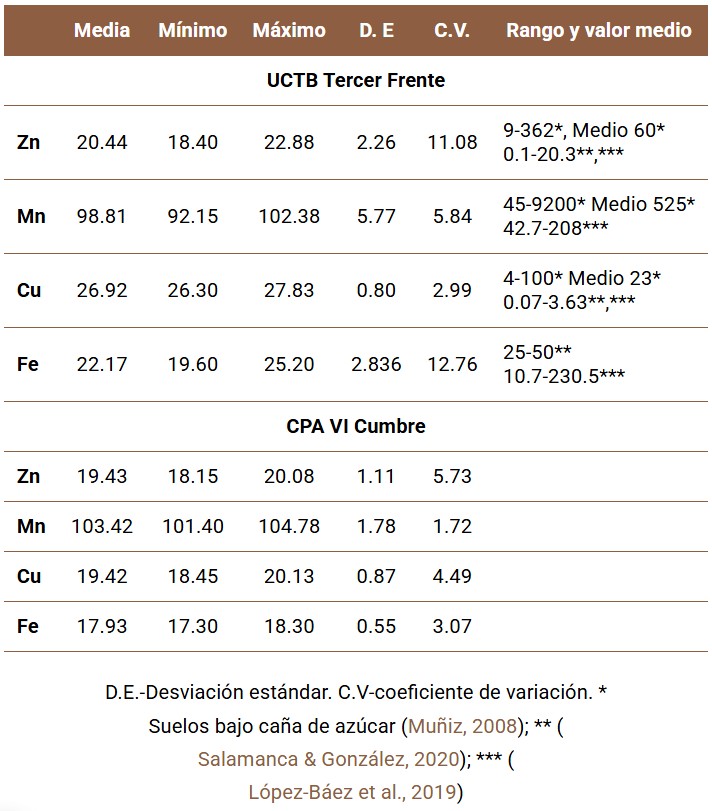
Micronutrient diagnosis in coffee plantations is essential to optimize fertilization and ensure coffee productivity and quality. This study evaluated micronutrient contents in soils and leaves of coffee trees in two seed banks in the Tercer Frente municipality, Santiago de Cuba, using atomic absorption spectrophotometry. Brown soils and leaves of varieties such as Caturra rojo, Laferno, and Coffea canephora were analyzed, measuring Zn, Cu, Mn, and Fe. The results showed that Zn, Cu, and Mn levels exceeded those reported in Colombia and Mexico, while Fe was lower. In the soil, organic matter, Ca, and Mg positively correlated with foliar Cu and Mn. The varieties exhibited significant differences: Coffea canephora accumulated more Zn, and Caturra rojo had higher Cu contents. The low foliar levels at the VI Summit indicated soil deficiencies, highlighting the need to adjust nutritional management according to genotype and local conditions. It is concluded that spectrophotometry is accurate for diagnosing micronutrients and that agronomic practices must be adapted to the specific demands of each variety.
Article Details

This work is licensed under a Creative Commons Attribution-NonCommercial 4.0 International License.
Those authors who have publications with this journal accept the following terms of the License Attribution-NonCommercial 4.0 International (CC BY-NC 4.0):
You are free to:
- Share — copy and redistribute the material in any medium or format
- Adapt — remix, transform, and build upon the material
The licensor cannot revoke these freedoms as long as you follow the license terms.
Under the following terms:
- Attribution — You must give appropriate credit, provide a link to the license, and indicate if changes were made. You may do so in any reasonable manner, but not in any way that suggests the licensor endorses you or your use.
- NonCommercial — You may not use the material for commercial purposes.
- No additional restrictions — You may not apply legal terms or technological measures that legally restrict others from doing anything the license permits.
The journal is not responsible for the opinions and concepts expressed in the works, they are the sole responsibility of the authors. The Editor, with the assistance of the Editorial Committee, reserves the right to suggest or request advisable or necessary modifications. They are accepted to publish original scientific papers, research results of interest that have not been published or sent to another journal for the same purpose.
The mention of trademarks of equipment, instruments or specific materials is for identification purposes, and there is no promotional commitment in relation to them, neither by the authors nor by the publisher.
How to Cite
References
Alberto, N. J., Ramalho, J. C., Ribeiro-Barros, A. I., Viana, A. P., Krohling, C. A., Moiane, S. S., Alberto, Z., Rodrigues, W. P., & Partelli, F. L. (2023). Diversity in Coffea arabica Cultivars in the Mountains of Gorongosa National Park, Mozambique, Regarding Bean and Leaf Nutrient Accumulation and Physical Fruit Traits. Agronomy, 13, 1162. https://doi.org/10.3390/agronomy13041162
Alloway, B. J. (2008). Zinc in Soils and Crop Nutrition (2nd ed.). International Zinc Association and International Fertilizer Industry Association.
Bragança, C. M., Prieto Martinez, H. E., Garcia Leite, H., Pereira Santos, L., Sediyama, C. S., Alvarez, V. H., & Lani, J. A. (2007). Acúmulo de B, Cu, Fe, Mn e Zn pelo cafeeiro Conilon. Ceres, 54(314), 398-404.
Carvalho, V. L., Cunha, R. L., & Silva, N. R. N. (2012). Alternativas de controle de doenças do cafeeiro. Coffee Science, 7(1), 42-49.
Da Silva, C. A., Azevedo, E., Pio, A., Machado, J., & Partelli, F. (2021). Diversidad genética en genotipos de Coffea canephora para la concentración de nutrientes en la hoja. Revista de la Facultad de Ciencias Agrarias UNCuyo, 23(1), 22-34.
Inthasan, J., Dechjiraratthanasiri, C., & Taksa-Udom, N. (2021). Influence of zinc and boron on nutrient concentration in coffee leaf and on coffee yield in northern Thailand. Maejo International Journal of Science and Technology, 15(1), 73-80.
López-Báez, W., Reynoso-Santos, R., Camas Gómez, R., & Santos-Clemente, E. C. (2019). Caracterización de los suelos cultivados con café (Coffea L.) en la Sierra Madre de Chiapas, México. Agroproductividad, 12(1), 53-58.
Malavolta, E., Graner, A., Sarruge, J. R., & Gomes, L. (1963). Estudos sobre a alimentação mineral do cafeeiro. XI. Extração de macro e micronutrientes na colheita, pelas variedades ‘Bourbon Amarelo’, ‘Caturra Amarelo’ e ‘Mundo Novo’. Turrialba, 13(3), 88-189.
Martinez, H. E., & Reis Jr, R. dos A. (2002). Adição de Zn e absorção, translocação e utilização de Zn e P por cultivares de cafeeiro. Scientia agrícola, 59, 537-542.
Morales-Ramos, V., Escamilla-Prado, E., Ruiz-Carbajal, R. A., Pérez-Sato, J. A., Velázquez-Morales, J. A., & Servín-Juárez, R. (2020). On the soil-bean-cup relationships in Coffea arabica L. Journal of the Science of Food and Agriculture, 100, 5434-5441.
Muñiz, O. (2008). Los microelementos en la agricultura. Agrinform.
Plaza Pérez, C. D., Pozza, E. A., Pozza, A. Z. A., Elmer, W. H., Bastos Pereira, A., da Silva Gomes Guimarães, D., Andrade Monteiro, A. C., & de Rezende, M. L. V. (2020). Boron, zinc and manganese suppress rust on coffee plants grown in a nutrient solution. European Journal of Plant Pathology, 156, 727-738. https://doi.org/10.1007/s10658-019-01922-9
Prieto Martinez, H. E., Scherrer Menezes, J. F., de Souza, R. B., Alvarez Venegas, V. H., & Gontijo Guimarães, P. T. (2003). Faixas críticas de concentrações de nutrientes e avaliação do estado nutricional de cafeeiros em quatro regiões de Minas Gerais. Pesquisa Agropecuária Brasileira, 38(6), 703-713. https://doi.org/10.1590/S0100-204X2003000600005
Quintão-Lana, R. M., de Oliveira, S. A., Quintão Lana, A. M., & de Faria, M. V. (2010). Levantamento do estado nutricional de plantas de Coffea arabica L pelo DRIS, na região do Alto Paranaíba - Minas Gerais. Revista Brasileira de Ciência do Solo, 34, 1147-1156.
Sadeghian, K. S. (2022). Nutrición del café. Consideraciones para el manejo de la fertilidad del suelo. Cenicafé. https://doi.org/10.38141/cenbook-0017
Sadeghian, S. (2020). Análisis foliar: Una guía para evaluar el estado nutricional del café. Avances Técnicos Cenicafé, 515, 4. https://doi.org/10.38141/10779/0515
Sadeghian, S. (2022). Nutrición del café: Consideraciones para el manejo de la fertilidad del suelo. Cenicafé. https://doi.org/10.38141/cenbook-0017
Salamanca, A., & González, H. (2020). Respuesta del café a la aplicación foliar de nutrientes. Revista Cenicafé, 71(2), 124-142. https://doi.org/10.38141/10778/71210
Schmidt, R., Silva, C. A. d., Dubberstein, D., Dias, J. R. M., Vieira, H. D., & Partelli, F. L. (2022). Genetic Diversity Based on Nutrient Concentrations in Different Organs of Robusta Coffee. Agronomy, 12, 640. https://doi.org/10.3390/agronomy12030640
Teixeira-Clemente, F. M. V. (2005). Faixas críticas de teores foliares de macro e micronutrientes no cafeeiro (Coffea arabica L) no primeiro ano de formação de lavoura [Master’s thesis]. Universidade Federal de Lavras.
Trejo-Téllez, L. I., Gómez-Merino, F. C., Morales-Ramos, V., Marín-Garza, T., Castañeda-Castro, O., & Pastelin-Solano, M. C. (2018). Concentración de macronutrimentos y micronutrimentos en granos de café (Coffea sp.) de diferentes orígenes. Agroproductividad, 11(4), 19-24.