Efecto de dosis de fertilizante de liberación controlada sobre el desarrollo de posturas de cafeto
Article Sidebar
Main Article Content
Abstract
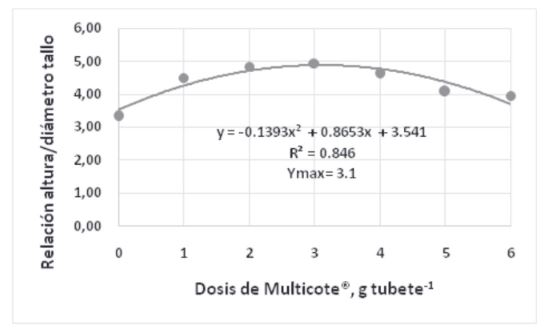
To evaluate the effect of fertilizer dose of slow liberation on the growth of Coffea arabica L. postures variety ‘ Isla 6-14 ‘ in plugs an experiment was developed in the nursery of the Institute of Agro-forest Investigations UCTB Tercer Frente, in the period December, 2017-May, 2019. A totally randomized design was used. The parcels were constituted by 54 plugs of 180 mL of capacity of those that 24 were evaluated. 6 dose were studied (0,1; 2; 3; 4; 5 and 6 g • plug-1) of Multicote, formula 18-6-12 applied to the moment to prepare the mixture (Brown sialytic soil/bovine manure 1/1). The height was measured; the diameter of the stalk at 1 cm of the soil, the foliate area, the dry mass of the aerial part, root system and total. The data were processed by means of variance analysis and the halves were compared with the Duncan test at 5 % of probability. The dry mass and foliated area data were adjusted to different equations. The application of Multicote increased the indicators evaluated until dose that oscillated between 2 and 3 g • plug-1 in dependence of the experimental year. Superior dose depressed some variables of growth of the postures, even with inferior values to the treatment without fertilizer. For the production of the coffees postures in plugs, using as substratum the Brown sialytic soil/bovine manure in proportion 1:1, the dose of 2 g of Multicote is recommended by plug.
Article Details

This work is licensed under a Creative Commons Attribution-NonCommercial 4.0 International License.
Those authors who have publications with this journal accept the following terms of the License Attribution-NonCommercial 4.0 International (CC BY-NC 4.0):
You are free to:
- Share — copy and redistribute the material in any medium or format
- Adapt — remix, transform, and build upon the material
The licensor cannot revoke these freedoms as long as you follow the license terms.
Under the following terms:
- Attribution — You must give appropriate credit, provide a link to the license, and indicate if changes were made. You may do so in any reasonable manner, but not in any way that suggests the licensor endorses you or your use.
- NonCommercial — You may not use the material for commercial purposes.
- No additional restrictions — You may not apply legal terms or technological measures that legally restrict others from doing anything the license permits.
The journal is not responsible for the opinions and concepts expressed in the works, they are the sole responsibility of the authors. The Editor, with the assistance of the Editorial Committee, reserves the right to suggest or request advisable or necessary modifications. They are accepted to publish original scientific papers, research results of interest that have not been published or sent to another journal for the same purpose.
The mention of trademarks of equipment, instruments or specific materials is for identification purposes, and there is no promotional commitment in relation to them, neither by the authors nor by the publisher.
How to Cite
References
Campinhos Júnior, E. e Y. K. Ikemori: Introdução de nova técnica na produção de mudas de essências florestais. Silvicultura, (28): 226-228, 1983.
Casierra Posada, F.; Ricardo, G. y J. E. Peña-Olmos: Estimación indirecta del área foliar en Fragaria vesca L., Physalis peruviana L., Accase llowiana (Berg.) Burret, Rubus glaucus L., Passiflora mollissima (Kunth) L. H. Bailey y Ficus carica L. Rev. U.D.C.A Act. & Div. Cient., 11 (1): 95-102. 2008.
Costa, A. C.; Decarlos Neto, A.; Ramos, J. D. e D. I. Borges: Alternativas para adubação de porta-enxertos de abacateiro ‘Quintal’ e seuefeito no pegamento de enxertia. Revista Brasileira de Fruticultura, Jaboticabal, 33 (4): 1283-1293, 2011.
Dias, R; e B. de Melo: Proporção de material orgânico no substrato artifcial para a produção de mudas de cafeeiro em tubetes. Ciênc. agrotec., 33 (1): 144-152, 2009.
Dickson, A; L.; Leaf; J. and F. Hosner: Quality Appraisal of White Spruce and White Pine Seedling Stock in Nurseries, Forest Cronicle, (36): 10-13, 1960.
Dobbs, C; Hernández, J. y F. Escobedo: Ecuaciones de biomasa aérea y área foliar basadas en métodos no destructivos para árboles urbanos de dos comunas de Chile Central. Bosque, 32(3): 287-296, 2011.
Espindula, M. C. R. J.; Teixeira, A. L.; Marcela Campanharo e J. R. Machado Dias: Volume de tubetes para produção de mudas clonais de Coffea canephora‘ Conilon – BRS OuroPreto. Em: IX Simpósio de Pesquisa dos Cafés do Brasil. Curitiba – PR. 6 pp., 2015.
Hernández, A. y col.: Nueva Versión de Clasifcación Genética de los Suelos de Cuba. La Habana: Instituto de Suelos. 40 pp., 1994.
Klooster, W. S.; Cregg, B. M.; Fernandez, R. T.and P. Nzokou: Growth and physiology of deciduous shade trees in response to controlled-release fertilizer. ScientiaHorticulturae, Amstersdam, (135): 71-79, 2012.
Marana. J. P.; É. Miglioranza, É.; de P. Fonseca, É.; e R. Hiroshi: Indices de qualidade e crescimento de mudas de café produzidas em tubetes. Ciência Rural, 38 (1):35-45, 2008.
Melo, B. de: “Estudos sobre a produção de mudas de cafeeiro (Coffea arabica L.) em tubetes” [inédito], tesis de candidatura. Universidade Federal de Lavras, Lavras, Brasil, 1999.
Mendonça, V.; Arruda, N. A. A.; Souza, H. A.; Teixeira, G. A.; Hafle, O. M. e J. D. Ramos: Diferentes ambientes e Osmocote® na produção de mudas de tamarindeiro (Tamarindus indica). Ciência e Agrotecnologia, Lavras, 32. (2): 391-397, 2008.
Morán Rodríguez, N.; Martínez Suárez, Felipe y Carlos Alberto Bustamante González: Efecto de diferentes fuentes de abono orgánico y momentos de fertilización en el desarrollo de posturas de cafetos producidas en tubetes de 180 cm3. Café Cacao, 18 (1): 29-34, 2019.
Oliveira, L. L.; Toleto; D. C.; Rezende, T. T.; Carvalho, S. P. de; Sousa, J. S. de; Livramento, D. E. do; Baliza, D. P. e D. R. Baquião Maia: Efeito de sacarose e de fertilizante de liberação lenta no sistema radicular de mudas obtidas por estacas caulinares de Coffea arabica L. Em: VIII Simpósio de Pesquisa dos Cafés do Brasil.
Salvador – BA. 6 pp., 25 a 28 de novembro de 2013. Oliveira, R. P.; Nino, A. F. P. e O. Nickel: Limpeza de patógenos e propagação in vitro de cultivares de pereira.
Pelotas: Embrapa Clima Temperado, (Embrapa Clima Temperado. Comunicado técnico, 104), 2004.
Pozza, A.A.A.; Guimarães; P.T.; Pozza, E. A.; Romaniello, M.M.; Martins, M. F.: Suprimento do fertilizante de liberação lenta na produção de mudas de cafeeiro em tubetes .Simpósio dos Cafés do Brasil. 4 pp., [s.f.].
Serrano, L. A. L.; Marinato, F. A.; Magiero, M. e G. M. Sturm: Produção de mudas de pimenteira-do-reino em substrato comercial fertilizado com adubo de liberaçãolenta. Revista Ceres, Viçosa, 59 (4): 512-517,2012.
Soto, F.: Estimación del área foliar en C. arabica L. a partir de las medidas lineales de las hojas. Cultivos Tropicales, 2 (3): 115-128, 1980.
Teixeira, P. C.; Rodrigues, H. S.; Lima, W. A. A.; Rocha, R. N. C.; Cunha, R. N. V. e R. Lopes: Influência da disposição dos tubetes e da aplicação de fertilizantes de liberação lenta, durante o pré-viveiro, no crescimento de mudas de dendezeiro (Elaeis guineensis Jacq.).
Ciência Florestal, Santa Maria, 19 (2): p. 157-168, 2009.
Vallone, H. S.; Guimarães, R. J., Guimarães Mendes, A. N.; Spaggiari Souza, C. A.; Luz da Cunha, R. e F. P. Dias: Diferentes recipientes e substratos na produção de mudas de cafeeiros. Ciênc. agrotec., 34 (1): 55-60, 2010.