Efecto de la fertilidad del sustrato en la respuesta de Theobroma cacao L. a la micorrización
Article Sidebar
Main Article Content
Abstract
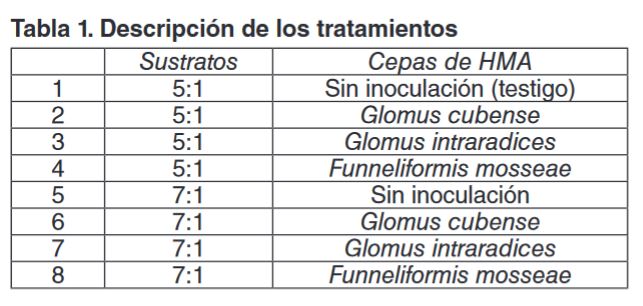
The investigation was developed in La Fidelina nursery of the Agroforest Enterprise and Coco Baracoa, Guantánamo, Cuba, to know the effect of the substratum fertility in the answer of the Theobroma cocoa L. to the micorrhization. Certified hybrid seeds were used by the Estación Experimental Agro-Forestal Baracoa. A Brown loose soil without carbonates was used. In a totally randomized with arrangement Bifactorial design the combination of two proportions of worm soil-humus it was studied (5:1 and 7:1 volumen/volumen) and four stumps of HMA: without inoculation, Glomus cubense, Glomus intraradices and Funneliformis mosseae. The inoculum in dose of 10 g by bag under the seed was applied. When the plants reach the five months of having sowed, in 5 postures of 10 that conformed each treatment, were evaluated the height, the diameter of the shaft, the dry mass, the foliate area, the quality index and the efficiency index . The postures of Th. cocoa L. responded to the inoculation of the different mycorrhizas stumps. The effect of the mycorrhizal inoculation differed according to the wealth of the substratum. Glomus intraradices was the most promissory stump and it showed a better action when inoculating in the substratum with smaller fertility. In the proportion 7:1 it increased the height in 9 %, the dry mass and the quality index in 30 % and the foliate area in 74 % with relationship to the witness. The efficiency of G. cubense, for the dry mass, was superior in the substratum with more fertility (5:1), while that of F. mosseae made it in the substratum with smaller fertility.
Article Details

This work is licensed under a Creative Commons Attribution-NonCommercial 4.0 International License.
Those authors who have publications with this journal accept the following terms of the License Attribution-NonCommercial 4.0 International (CC BY-NC 4.0):
You are free to:
- Share — copy and redistribute the material in any medium or format
- Adapt — remix, transform, and build upon the material
The licensor cannot revoke these freedoms as long as you follow the license terms.
Under the following terms:
- Attribution — You must give appropriate credit, provide a link to the license, and indicate if changes were made. You may do so in any reasonable manner, but not in any way that suggests the licensor endorses you or your use.
- NonCommercial — You may not use the material for commercial purposes.
- No additional restrictions — You may not apply legal terms or technological measures that legally restrict others from doing anything the license permits.
The journal is not responsible for the opinions and concepts expressed in the works, they are the sole responsibility of the authors. The Editor, with the assistance of the Editorial Committee, reserves the right to suggest or request advisable or necessary modifications. They are accepted to publish original scientific papers, research results of interest that have not been published or sent to another journal for the same purpose.
The mention of trademarks of equipment, instruments or specific materials is for identification purposes, and there is no promotional commitment in relation to them, neither by the authors nor by the publisher.
How to Cite
References
Azizah, H. and P. Ragu: Growth response of Theobroma cacao L. seedlings to inoculation with vesicular- arbuscular mycorrhizal fungi. Plant and Soil, 96, 279285, 1986.
Azizah, H. and P. Ragu: Preliminary observations on Gigaspora species in Theobroma cacao L. Seedlings. In: Ismail Sahid, Zainal Abidin, A. Hasan, A. Latiff Moahmedand and A. Salam Babji (eds,), Collection of Working Papers 4, Research Priorities in Malaysian Biology, pp., 347-351,1984.
Barea, J. M. y col.: Morfología, anatomía y citología de las micorrizas VA. En: Fijación y Movilización de Nutrientes. Madrid. Tomo II. Pp. 150-173, 1991.
Bustamante, C.; Ochoa, M.; Sánchez, C.; Rivera, R. y Maritza Rodríguez: Interacción entre bacterias fijadoras de N (Azotobacter) y las micorrizas arbusculares en la biofertilización de posturas de Coffea arábica L. Café Cacao, 3 (3): 47–50, 2002.
Cuenca, Gisela; Herrera, R. and E. Meneses: Effects of VA mycorrhiza on the growth of cacao seedlings under nursery conditions in Venezuela. Plant and Soil, 126: 71-78, 1990.
Cuba, Ministerio de la Agricultura: Instrucciones Técnicas para el Cultivo y Cosecha del Café y Cacao: Dirección Nacional de Café y Cacao, CIDA. La Habana, pp. 147-208, 1987.
Dickson, A. et al.: Quality Appraisal of White Spruce and White Pine Seedling Stock in Nurseries, Forest Cronicle, 36: 10-13, 1960.
Fernández, F.: “Manejo de las asociaciones micorrízicas arbusculares sobre la producción de posturas de cafeto (C. arabica L. var. Catuaí) en algunos tipos de suelos” [inédito], tesis de candidatura. Instituto Nacional de Ciencias Agrícolas (INCA), San José de las Lajas, Mayabeque, La Habana, Cuba, 1999. Gerdeman, J. W. and J. M. Trappe: Endogonaceae In The Pacific Northwest. Mycología Memoir, 5: 1-76,1974.
Hernández, A.; Pérez, J. M.; Bosch, D. y N. Castro: Clasificación de los suelos de Cuba, Ed, Ediciones INCA, Mayabeque,La Habana, Cuba, 93 pp., 2015.
Herrera-Peraza, R.; Chantal, Hamel; Fernández, F.; Ferrer, R. L. and E. Furrazola: Soil–strain compatibility: the key to effective use of arbuscular mycorrhizal inoculants? Mycorrhiza, 21:183–193, 2011.
InfoStat: Versión 1,0 Universidad, Nacional de Córdova, Argentina, 2012.
Kumar, N.; Kumar, A.; Shucla, A.; Kumar, S.; Uthappa, A.; and O. P. Chaturvedi: Effect of Arbuscular Microrrhiza Fungi (AMF) on Early Seedling Growth of Some Multipurpose Tree Species. International Journal of Current Microbiology and Applied Sciences, 6 (7): 3885-3892, 2017.
Miyakasa, S. C. and M. Habte: Plant mechanisms and mycorrhizal symbioses to increase phosphorus uptake efficiency, Commun, Soil Science, Plant Anal, 32, 1101-1147, 2001.
Mosse, B.; et al.: Plant growth responses to vesicular arbuscular mycorrhiza V. Phosphate uptake by tree plants species from P-deficient soils labelled with 32P. New Phytol., 72: 809-811, 1973.
Navarro, D.; Grave de Peralta, G.; González, J. A.; Bustamante, C. A.; García, R. I.; Tabares, G. y R. A. Miranda: Método de estimación del área foliar en Theobroma cacao Lin. a partir de las medidas lineales de las hojas. Café Cacao, 1(1): 46-49, 1998.
Navarro, A.; Adriana Zulay; Rozo, M. y Laura Yolima: Evaluación del potencial biofertilizante de bacterias diazótrofas aisladas de suelos con cultivo de cacao (Theobroma cacao L.). Acta Agronómica, 63 (3): 1-12, 2014.
Rivera, R. y col.: Efecto de la inoculación con hongos micorrizógenos (v.a) y bacterias rizosféricas sobre el crecimiento de las posturas de cafeto. Cultivos Tropicales, 18(3): 15-23, 1997.
Rivera, R.; González, P.; Hernández, A.; Gloria Martín; Ruíz L.; Kalyanne Fernández; Simón, J.; Milagros García; Pérez, A., Riera, M.; Bustamante, C.; Joao J. y M. Ruiz: La importancia del ambiente edáfico y del pH sobre la efectividad y la recomendación de cepas eficientes de HMA para la inoculación de los cultivos. En: Resúmenes Congreso Cubano de la Ciencia del Suelo, 2016.
Selva, F. F.; Columbié, Á.; Sánchez. E.; Martínez, F.; González, J. A.; Márquez, J. J.; Lambertt, W.; Menéndez, M. y G. A. Matos: Estudio prospectivo de la cadena productiva del cacao en Cuba. En: Informe Final Proyecto Ramal 0615, 34 pp., septiembre, 2004.
Siqueira, J. O. y A. Franco: Biotecnología do solo Fundamentos e Perspectivas. Ciencias nos Trópicos Brasileiros. Serie Agronomía, 235 pp., 1988.
Viera, W.; Ampaña, D.; Lastra, A.; Vásquez, W.; Vitere, P. y A. Sotomayor: Micorrizas nativas y su efecto en dos microinjertos de tomate de árbol (Solanum betaseum Cav.). Bioagro, 29 (2): 105-114, 2017.