Diversification of the production in an agriculture coffee ecosystem, under sostenibility principle
Article Sidebar
Main Article Content
Abstract
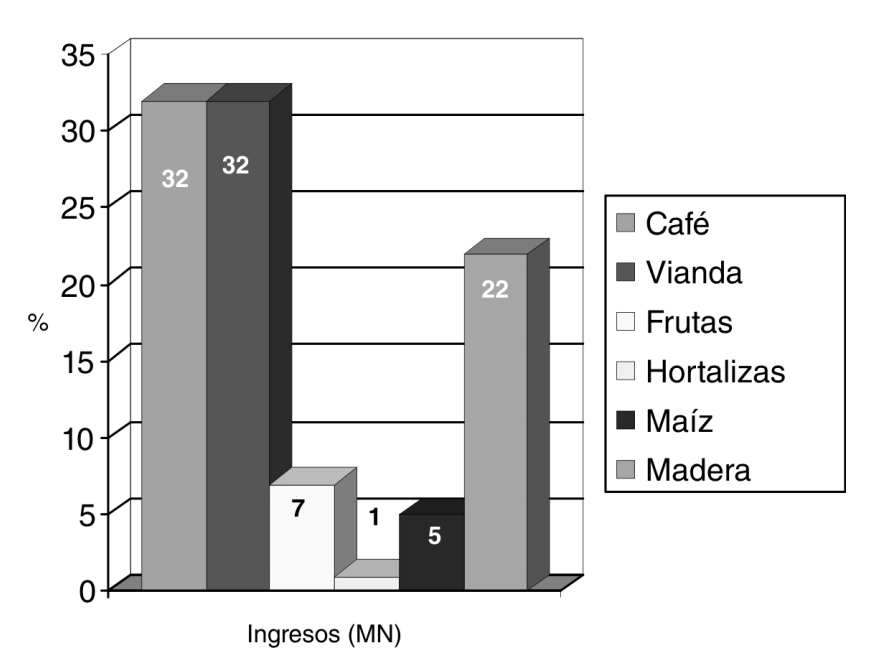
With the objectives of diversifying the productions in a coffee property, to increase the coffee productions with the employment of sustainability technical and to increase the producer revenues, this work was carried out in La Esperanza property, belonging to the usufructuary production type, located in Arroyo Rico, Tercer Frente municipality, Santiago de Cuba province, for that which an agro ecological diagnosis of the productive space was carried out and the main characteristics of the area were identified. The diversification of the production was carried out by means of the establishment of intercropping cultivations among the coffee trees, as well as in the areas of perimeter and others that are not capable for the cultivation of the coffee. The commercialization of the diversified production entered 47.38 MP in total, with balance of 39.42 MP, in the evaluated period; The 32.29 and 67.71 % of the entrance total corresponded respectively to the coffee and other productions. With these results it was possible to improve the life quality of the producer and their family, when having bigger revenues for the acquisition of material resources for the development and maintenance of their property, consumption goods for the home, besides improving the feeding, when including in their diet the vegetable consumption, vegetables and fruits, at the same time that contributed to the reduction of the negative impact of the degrading factors of the means.
Article Details

This work is licensed under a Creative Commons Attribution-NonCommercial 4.0 International License.
Those authors who have publications with this journal accept the following terms of the License Attribution-NonCommercial 4.0 International (CC BY-NC 4.0):
You are free to:
- Share — copy and redistribute the material in any medium or format
- Adapt — remix, transform, and build upon the material
The licensor cannot revoke these freedoms as long as you follow the license terms.
Under the following terms:
- Attribution — You must give appropriate credit, provide a link to the license, and indicate if changes were made. You may do so in any reasonable manner, but not in any way that suggests the licensor endorses you or your use.
- NonCommercial — You may not use the material for commercial purposes.
- No additional restrictions — You may not apply legal terms or technological measures that legally restrict others from doing anything the license permits.
The journal is not responsible for the opinions and concepts expressed in the works, they are the sole responsibility of the authors. The Editor, with the assistance of the Editorial Committee, reserves the right to suggest or request advisable or necessary modifications. They are accepted to publish original scientific papers, research results of interest that have not been published or sent to another journal for the same purpose.
The mention of trademarks of equipment, instruments or specific materials is for identification purposes, and there is no promotional commitment in relation to them, neither by the authors nor by the publisher.
How to Cite
References
Arañó, L.; Ramajo, J. L.; Delira Navarro; Verdecia, M. y A. Yero: Resultados de la aplicación de tecnologías en el desarrollo cafetalero de cuatro fincas de la Unidad Básica de Producción Cooperativa “14 de Junio”. Café Cacao, 10 (1): 12-16, 2011.
Cifuentes, L. E.: “Caficultura Orgánica Sostenible en el Proyecto IMCA” [inédito], tesis de candidatura. BUGA, Colombia, 1997.
Del Ángel, V.: El modelo de desarrollo sostenible de la agricultura, de cara al siglo XXI. En: Panel de Caficultura Sostenible, XVIII Simposio Latinoamericano de Caficultura. — Costa Rica: ICAFÉ IICA, pp. 12-22, 1997.
Díaz, W.; Caro, P.; Bustamante, C.; Sánchez, C.; Maritza Idilia Rodríguez; Vázquez, E.; Grave de Peralta, G.; Ramajo, J.; Ramos, R.; Delira Navarro; Fernández, I.; Martínez, F.; Yojana Rodríguez; Arañó, L.; Yero, A. y N. Moran: Instructivo Técnico Café Arábico. Instituto de Investigaciones Agro-Forestales. 137 Pp., 2013.
Hernández y col.: Nueva versión de la clasificación genética de los suelos de Cuba. La Habana: Instituto de Suelos, 75 Pp., 1994.
Jiménez, M. I.: Historia de Costa Rica, Pp. 35-45, 1ra Ed.: San José, Costa Rica, 1980. ONU, Organización de Naciones Unidas: Informe sobre desarrollo humano, 1998.
Pohlan, J. y col.: Transformación de los cafetales y cacaotales convencionales en Centroamérica y el Caribe a sistemas sostenibles. En: Simposio Internacional de Café y Cacao. Programa, conferencias y resúmenes. Cubacafé ‘99. 25-27 noviembre. Santiago de Cuba. Cuba. 89 Pp., 1999.
Rodríguez, V.; Soraya García; Joseph, J.; Ruiz, J. y Marie la Laborit: Sostenibilidad en la producción en predios de campesinos del municipio Yateras. Café Cacao, 3 (1): 46-48, 2002.
Rodríguez, F.; Viñals, R.; Ramos, R. y O. Fernández: In fluencia de las buenas prácticas agrotécnicas en los resultados productivos de la UBPC cafetalera “Seguidores de Che”. Café Cacao, 10 (1): 6 - 10, 2011.
Rojas, Y.; Rodríguez, V. y A, Pérez: Modelo para la sostenibilidad agraria. Caso Campo Alegre, municipio Páez del estado bolivariano de Miranda. Café Cacao, 12 (1): 54 - 61, 2013.
Staver, Ch.; Aguilar, A.; Mendoza, R.; Viera, C.; Zelaya, H. y J. Barrios: De cafetales poco productivos a cafetaleros gerentes ecológicos, en el centro oriente de Honduras: Resultados de un proceso grupal de aprendizaje y experimentación por etapas del cultivo. Café Cacao, 3 (1): 21-22, 2002.