Effect of Nutripel on the growth of coffee and cocoa plants
Article Sidebar
Main Article Content
Abstract
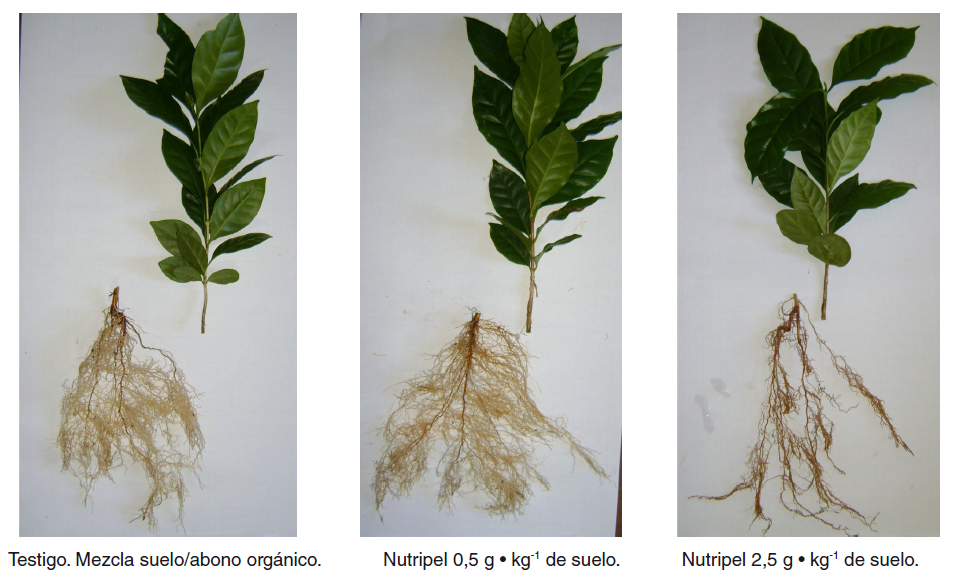
The Nutripel is a Canadian fertilizer product made from starting from several microorganisms that are used to digest the mire of residual municipal that have dried off and compacted to high temperatures. In the 2008 was registered in the Central Registration of Cuba Fertilizers. In 2009 the effect of growing dose of Nutripel was studied in indicators of seedlings development of coffees (Coffea arabica L.) and cocoa (Theobroma cacao L.) in comparison with a witness (soil/organic manure 3/1 + foliate urea). Starting from the doses recommended by the maker 1 g • kg soil-1, the doses 0,5;1; 1,5; 2; 2,5 and 3 g • kg soil-1 were studied. The bio-fertilizer effect was evaluated in the height, couple of leaves, dry mass, and root length’s in seedlings taken place by seeds. There was positive effect of the Nutripel in the growth of the coffees seedlings. The Nutripel applications in dose of 0,5 g • kg soil-1 propitiated similar values statistically to those reached in soil organic manure in mixture 3/1 for the height, diameter of the shaft, couple of leaves, top dry mass and radical and foliar area. The lengthy of the root was superior statistically in 24 % the treatment with Nutripel. Superior dose to the 2 g • kg soil-1 had a depressive effect in the diameter of the shaft, the lengthy of the root, the air dry mass and radical. In the cocoa the effect of the Nutripel in the evaluated indicators was positive but of smaller intensity that in the coffee. Starting from the dose of 2,5 g of Nutripel • kg-1 of soil a depressive effect was observed in the couples of leaves, the dry weight of leaves, shaft and root as well as the foliar area of the seedlings of cocoa.
Article Details

This work is licensed under a Creative Commons Attribution-NonCommercial 4.0 International License.
Those authors who have publications with this journal accept the following terms of the License Attribution-NonCommercial 4.0 International (CC BY-NC 4.0):
You are free to:
- Share — copy and redistribute the material in any medium or format
- Adapt — remix, transform, and build upon the material
The licensor cannot revoke these freedoms as long as you follow the license terms.
Under the following terms:
- Attribution — You must give appropriate credit, provide a link to the license, and indicate if changes were made. You may do so in any reasonable manner, but not in any way that suggests the licensor endorses you or your use.
- NonCommercial — You may not use the material for commercial purposes.
- No additional restrictions — You may not apply legal terms or technological measures that legally restrict others from doing anything the license permits.
The journal is not responsible for the opinions and concepts expressed in the works, they are the sole responsibility of the authors. The Editor, with the assistance of the Editorial Committee, reserves the right to suggest or request advisable or necessary modifications. They are accepted to publish original scientific papers, research results of interest that have not been published or sent to another journal for the same purpose.
The mention of trademarks of equipment, instruments or specific materials is for identification purposes, and there is no promotional commitment in relation to them, neither by the authors nor by the publisher.
How to Cite
References
Aguilar, P.; Bustamante, C. y F. Martínez: Efecto de las micorrizas vesiculares arbusculares, Azotobacter y bacterias solubilizadoras de fósforo en viveros de cacao. En: 2. Encuentro Nacional de Agricultura Orgánica. La Habana, 17-19 Mayo 1995. La Habana (Cuba). ACAO. p. 57-58, 1995.
Aguirre, J.; Mendoza, A.; Cadena, J. y C. Avendaño: Efecto de la biofertilización en vivero del cacao (Theobroma cacao L.) con Azospirillum brasilense Tarrand, K Döbereiner y Glomus intraradices Schenk et Smith. Interciencia, 32(8):441-546, 2007.
Bustamante, C.; Ochoa, M.; Sánchez, C.; Rivera, R. y Maritza Rodríguez: Interacción entre bacterias fijadoras de nitrógeno (Azotobacter) y las micorrizas arbusculares en la biofertilización de posturas de Coffea arabica. Café Cacao, 3(3): 47-50, 2002.
Castillo, Z. y H. Parra: Efecto tóxico del cobre en semilleros de café. Cenicafé, 10 (4): 109-117, 1959.
Hernández, A. y col.: Nueva Versión de Clasificación Genética de los Suelos de Cuba. La Habana: Instituto de Suelos. 40 pp., 1994.
Rodríguez, V.; Lobaina, J.; Bustamante, C. y G. Suárez: Uso de bioabono procedente de leguminosas y gramíneas en la producción de posturas de Coffea canephora variedad Robusta. Café Cacao, 2(1); 49-52, 2001.
Rodríguez, V.; Menéndez, M.; Mercedes Pierra; Mireya Cabrera y F. Coll: Efecto de diferentes dosis de brasinoesteroides (Biobras 16) en la producción de posturas de Theobroma cacao L. Café Cacao, 6(1-2): 9 -15, 2005.
Navarro, Delira; González, J. A.; Bustamante, C. y G. Grave de Peralta: Método de estimación del área foliar en posturas de Theobroma cacao a partir de las medidas lineales de las hojas. Café Cacao, (1)1: 4649, 1998.
Sánchez, C.; Rivera, R.; Cupull, R.; González, C.; Ferrer, M. e Yraida Delgado: Comportamiento de cepas de hongos micorrizógenos (HMA) sobre el desarrollo de posturas de cafetos en un suelo fersialítico rojo lixiviado. Café Cacao, 6 (1-2): 27-32, 2005.
Soto, F.: Estimación del área foliar en Coffea arabica L. a partir de medidas lineales de las hojas. Cultivos Tropicales, 2(3): 115-128,1980.