Valuation of the agricultural productions in courts and family orchards of the coffee community Rihíto of Matías of Tercer Frente
Article Sidebar
Main Article Content
Abstract
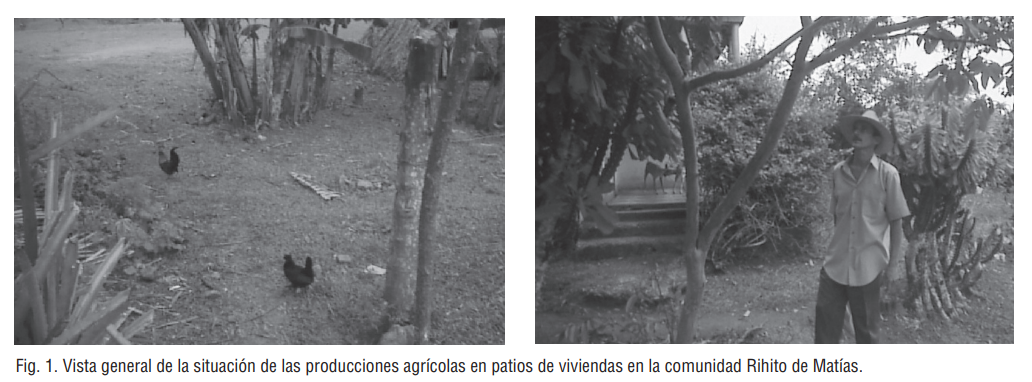
The work was developed in the period understood between February and December of the 2006, in the “Rihíto of Matías” community, located to more than 360 msnm in the Tercer Frente municipality, Santiago de Cuba province. The valuation was made in a sample that included an universe of 49 family nuclei. T the productions were diagnosed and characterized by means of the observation technical, interviews, surveys, the direct contact with the producers use, as well as through the evaluation and the agreement among the technicians and involved in the investigation. 49 orchards and 7 family orchards were chosen in those that were carried out a census of the existent agricultural productions. It was determined the predominance, diversity and frequency in that were found each one of these productions. One investigated about the demands and restlessness of the producers, as well as for the cultivations of their preference. The production of foods was insufficient with low use of the potentialities of the soil, alone in 64.3% of the orchards and diagnosed family orchards were a productive line at least; with prevalence of the cultivation of fruit-bearing. The cultivations of vegetables and of grains were not in none of the orchards and or visited family orchards. The community ones were shown interested to improve and to increase the cultivations in their orchards and to receive some type of technical training in the agriculture.
Article Details

This work is licensed under a Creative Commons Attribution-NonCommercial 4.0 International License.
Those authors who have publications with this journal accept the following terms of the License Attribution-NonCommercial 4.0 International (CC BY-NC 4.0):
You are free to:
- Share — copy and redistribute the material in any medium or format
- Adapt — remix, transform, and build upon the material
The licensor cannot revoke these freedoms as long as you follow the license terms.
Under the following terms:
- Attribution — You must give appropriate credit, provide a link to the license, and indicate if changes were made. You may do so in any reasonable manner, but not in any way that suggests the licensor endorses you or your use.
- NonCommercial — You may not use the material for commercial purposes.
- No additional restrictions — You may not apply legal terms or technological measures that legally restrict others from doing anything the license permits.
The journal is not responsible for the opinions and concepts expressed in the works, they are the sole responsibility of the authors. The Editor, with the assistance of the Editorial Committee, reserves the right to suggest or request advisable or necessary modifications. They are accepted to publish original scientific papers, research results of interest that have not been published or sent to another journal for the same purpose.
The mention of trademarks of equipment, instruments or specific materials is for identification purposes, and there is no promotional commitment in relation to them, neither by the authors nor by the publisher.
How to Cite
References
Ciencia y Técnica: Programa Nacional de Ciencia e Innovación Tecnológica. En: Convocatoria. Manuscrito. MINAG, INAF La Habana, Cuba 7 Pp., 2004.
Cuba. Ministerio de Ciencia, Tecnología y Medio Ambiente, Resolución No. 44/2012, -- 10 Pp., 2012.
Fernández, I.; Délira Navarro: Fajardo, O. y M. J. Verdecia: Valoración de las producciones agrícolas en patios y huertos familiares de la comunidad “Arroyo Rico” del Tercer Frente. Café Cacao 8 (2): 36-38, 2007.
Gamboa, Lorena y María C. Criollo: Forestería análoga y su rol en la recuperación de ecosistemas y el cambio climático, Leisa Revista de Agroecología 27(2): 8–12, 2011.
García, María F.: Técnicas de organización y producción Rural. Enciclopedia Científica para el Fomento Agrario. ISBN 9789974-8170-3-6: Uruguay, 2011.
Márquez, S. M., F. Funez y N. Valdés: Experiencias agroecológicas locales en el municipio La Palma como modelo para el sistema alimentario Cubano. Revista de Agroecología Leisa, Perú, 27(3): 16 – 18, 2011.
México. Memorias Diplomado Internacional en Fruticultura Sostenible. — México: Universidad Autónoma de Chiapas, 1999. — p.1.
MINAG. Ministerio de la Agricultura: Política del Café y el Cacao de la República de Cuba. La Habana. Manuscrito, 10 Pp., 2012.
Monsalve, Sofía y Philip Seufert: El Acaparamiento de tierras y de recursos naturales: violaciones del derecho y una alimentación adecuada. Leisa Revista de Agroecología 27(4): 5 – 8, 2012.
Pohlan, J: Transformación de los cafetales y cacaotales convencionales en Centroamérica y el caribe a sistemas sostenibles. En: Simposio Internacional de Café y Cacao. Programa, Conferencias y Resúmenes. Cuba Café´ 99. -- Santiago de Cuba, Pp.89, 1999.