Effect of the rehabilitation method in the affectations caused by insects in plantations of Theobroma cacao Lin.
Article Sidebar
Main Article Content
Abstract
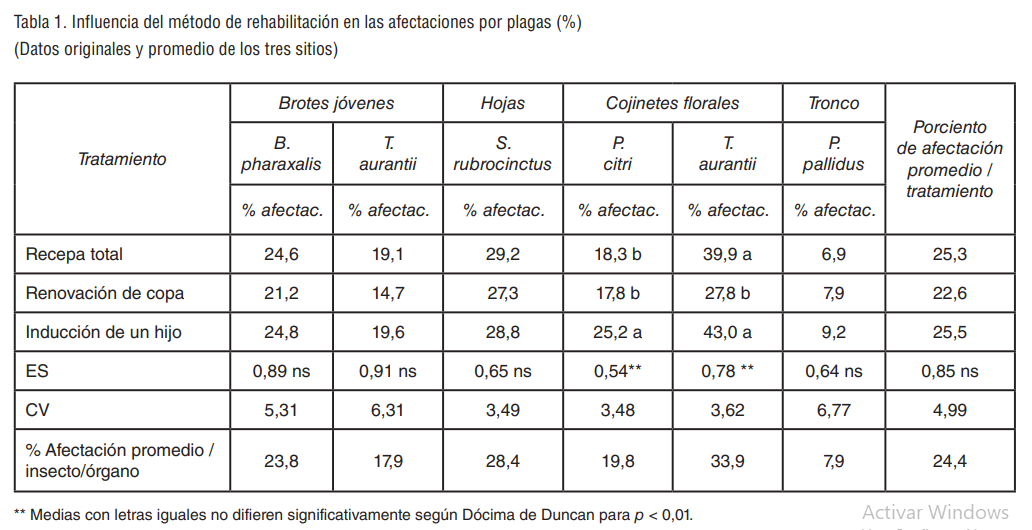
The work was developed in the Estación Experimental Agroforestal de Baracoa in the period of March of 2010 to September of 2012 in three experimental places belonging to the Enterprise of Coffee and Cocoa of Baracoa, Guantánamo, located in Naranjal del Toa, La Poa and Saibá with the objective of determining the affectations caused by insects in plantations of cocoa rehabilitated by three methods: Total Back cutting, Foliage Renovation and a Son’s Induction. In each experimental place they were selected 15 plants at random by treatment and in each one of them was evaluated bimonthly leaves, young buds, floral bearings and trunk, scoring what it plagues it was present. The percentage of affectation was determined. They were detected affecting the cultivation: Bocchoropsis pharaxalis Druce (in young buds), Selenothrips rubrocinctus Giard (in leaves), Toxoptera aurantii (Boyer) (in young buds and floral bearings), Planococcus citri Risso (in floral bearings) and Pseudonymex pallidus (in trunk). The biggest percentajes of affectation were obtained in the Son’s Induction (25.5 %) and the minors in Foliage Renovation (22.6 %). T. aurantii (Boyer) in floral bearings (33.9 %) those that more affected was while P. pallidus had alone 7.9 % of affectation in trunk.
Article Details

This work is licensed under a Creative Commons Attribution-NonCommercial 4.0 International License.
Those authors who have publications with this journal accept the following terms of the License Attribution-NonCommercial 4.0 International (CC BY-NC 4.0):
You are free to:
- Share — copy and redistribute the material in any medium or format
- Adapt — remix, transform, and build upon the material
The licensor cannot revoke these freedoms as long as you follow the license terms.
Under the following terms:
- Attribution — You must give appropriate credit, provide a link to the license, and indicate if changes were made. You may do so in any reasonable manner, but not in any way that suggests the licensor endorses you or your use.
- NonCommercial — You may not use the material for commercial purposes.
- No additional restrictions — You may not apply legal terms or technological measures that legally restrict others from doing anything the license permits.
The journal is not responsible for the opinions and concepts expressed in the works, they are the sole responsibility of the authors. The Editor, with the assistance of the Editorial Committee, reserves the right to suggest or request advisable or necessary modifications. They are accepted to publish original scientific papers, research results of interest that have not been published or sent to another journal for the same purpose.
The mention of trademarks of equipment, instruments or specific materials is for identification purposes, and there is no promotional commitment in relation to them, neither by the authors nor by the publisher.
How to Cite
References
Abreu, J. M.; Nakayama, de K.; Benton, F. P.; da Cruz, P. F.; Ferraz, E. C. A.; Menezes, M. y G. E. Smith: Manejo das pragas do cacaueiro. Bahía, Brasil. CEPLAC/CEPEC, 32 Pp., 1989.
Crespo, E. y F. Crespo: Cultivo y beneficio del cacao CCN 51. Ed. El Conejo. 1 ed. Quito, Ecuador. p. 4. 1997.
CUBA, MINAG: Segunda reunión de metodología sobre señalización y pronóstico.--La Habana: Dirección Nacional de Sanidad Vegetal. Pp. 14-15, 1979.
Delabie, J. H. C. e I. M. Cazorla: Daños causados por Planococcus citri Risso (Homóptera: Pseudococcidae) na produçao do cacaueiro. Agrotrópica 3(1): 53-57, 1991.
Enríquez, G.: El cultivo del cacao. CATIE. Turrialba, Costa Rica. Pp.131-137, 1983.
Enríquez, G. A.: Curso sobre el Cultivo del Cacao. Centro Agronómico Tropical de Investigación y Enseñanza. Turrialba. p. 178, 1985.
Grisales, A y G. Cubillos: Rehabilitación de poblaciones de cacao deterioradas por escoba de bruja mediante el método de renovación de la copa. El Cacaotero Colombiano (31): 36-41, 1985.
Hernández, D.: Incidencia del enrollador de la hoja del cacao en Baracoa. En: Informe anual de Señalización y Pronóstico de la ETPP Baracoa, 14 Pp., 1994.
Hernández, A. J.: Nueva versión de la clasificación genética de los suelos de Cuba. La Habana. Ministerio de la Agricultura. 23p. 1999.
Lambertt, W. y F. Selva: Inventario de plagas en plantaciones de Theobroma cacao Lin en el macizo montañoso de Baracoa. En: CICTA – 11. 4to Encuentro Latinoamericano y del Caribe sobre Cacao y Chocolate. 2008. ISBN 978 – 959 – 282 – 081– 4, 2008.
Lambertt, W., G. Matos, M. Menéndez, A. Oliveros, A. Columbié y Odalina Hernández: Plagas detectadas en plantaciones establecidas de Theobroma cacao Lin en Baracoa. Café Cacao 3(1): 85-88, 2002a.
Lambertt, W.; Matos, G.; Menéndez, M.; Selva, F. y A, Columbié: Afectaciones por las principales plagas en plantaciones de cacao con diferentes densidades de árboles de sombra en el macizo montañoso de Baracoa. Café Cacao 7(2): 3-7, 2006.
Lambertt, W., Menéndez, M.; Selva, F.; Oliveros, A.; Mercedes Pierra; Columbié, A. y E. Sánchez: Afectaciones y pérdidas provocadas por P. citri Risso en cojinetes florales de Theobroma cacao Lin. Café Cacao 3(1): 77-78, 2002b.
Lambertt, W.; Clapé, P.; Suárez, M. y A. Nariño: Principales plagas del Theobroma cacao Lin. en el macizo montañoso de Baracoa. En: 5to Encuentro Latinoamericano y del Caribe sobre Cacao y Chocolate. Memorias CICTA-12. ISBN 978959-7003-42-7, 2013.
López, R.: El cacao en Tabasco. 1 ed. México. Ed. Univ. Autónoma de Chapingo. p. 113. ISBN-968-884-029-7, 1987.
Martínez, E.; Barrios, G.; Sanromá, L. y R. Santos: Manejo Integrado de Plagas. Manual Práctico. Centro Nacional de Sanidad Vegetal (CNSV), Cuba, 2006.
Matos, G.; Blaha, G.; Mireya Cabrera y P. Pérez: Influencia de las hormigas Pseudonymex pallidus en la presencia de Phytophthora palmivora en el cacao. Café y Cacao 1(2): 20-25, 1998.
Moreira, M. D.: Rehabilitación de plantaciones de cacao mediante el uso de chupones. Estación Experimental Tropical. Boletín Divulgativo (242) 11 Pp., 1993.
Paliz, V. y J. Mendoza: Insectos de cacao. En: Manual del cultivo del cacao. Manual No 25. Quevedo, Ecuador. INIAP. –2.ed. p. 111, 1993.
Quiroz, J. y F. Amores: Rehabilitación de plantaciones tradicionales de cacao en Ecuador. Manejo Integrado de Plagas (63): 73 - 80, 2002.
Rudgard, S. A. and T. Anderbrhan: Predicting the cost-benefices of sanitation pruning for the management of witches’ broom diseases. Hertford (RU). Stephen Austin & Sons. Pp. 341344, 1998.
Sneder, G. W. y W. D. Cochran: Métodos Estadísticos. México: Continental S.A., Pp. 683-685, 1977.
Tur, Norma S. y L. Vázquez: Insectos detectados en el cultivo del cacaotero en la provincia Guantánamo. Protección de plantas 1(1):85-88, 1991.
Vaz, A.: Rehabilitación de cacaotales, conceptos básicos. Módulo de capacitación para productores. En: Proyecto Agro-Forestal CATIE/GTZ. CATIE. Turrialba, Costa Rica. 31 p. 1995.