Evaluation of the pleurotina like organic manure for the production of postures of inter specifics grafts of coffee
Article Sidebar
Main Article Content
Abstract
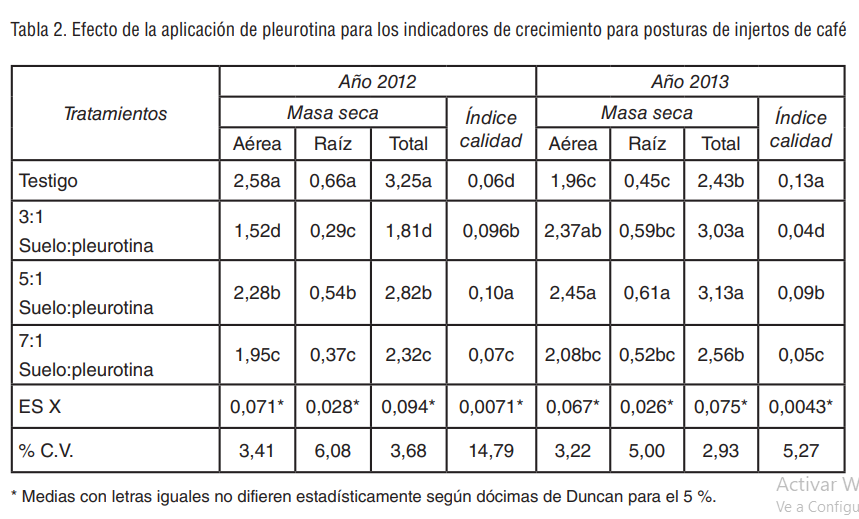
In the production of the edible mushrooms, the remanent substratum (pleurotina) it shows qualities that allow their use like organic fertilizer, which has been evaluated in the cultivation of plants of vegetables and vegetables and at the same time it is a road of managing the agricultural by-products. The objective of the investigation carried out during the years 2012 and 2013 in the Estación Experimental Agroforestal Tercer Frente, Santiago de Cuba was to evaluate the use of the pleurotina like organic manure for the production of postures of interespecifics grafts of coffee. Proportions of Brown soil/Pleurotina 3:1, 5:1 and 7:1 and a witness (3:1 soil: bovine manure) (v/v) were used. When more than 80% of the grafts were suitable, the height, the diameter of the stalk, the air and radical dry mass was evaluated, the area to foliate and the index of quality of the postures. The statistical analysis was carried out according to the STATISTICA program and the Duncan test was used for the comparison of the stockings. The grafts grown in the mixture soil: Pleurotina (5:1) they showed significantly superior values to the rest of the substratum in all the evaluated indicators. The above-mentioned facilitates to recommend the use of the Pleurotina like source of organic manure for the production of postures of coffee obtained by the way of grafts.
Article Details

This work is licensed under a Creative Commons Attribution-NonCommercial 4.0 International License.
Those authors who have publications with this journal accept the following terms of the License Attribution-NonCommercial 4.0 International (CC BY-NC 4.0):
You are free to:
- Share — copy and redistribute the material in any medium or format
- Adapt — remix, transform, and build upon the material
The licensor cannot revoke these freedoms as long as you follow the license terms.
Under the following terms:
- Attribution — You must give appropriate credit, provide a link to the license, and indicate if changes were made. You may do so in any reasonable manner, but not in any way that suggests the licensor endorses you or your use.
- NonCommercial — You may not use the material for commercial purposes.
- No additional restrictions — You may not apply legal terms or technological measures that legally restrict others from doing anything the license permits.
The journal is not responsible for the opinions and concepts expressed in the works, they are the sole responsibility of the authors. The Editor, with the assistance of the Editorial Committee, reserves the right to suggest or request advisable or necessary modifications. They are accepted to publish original scientific papers, research results of interest that have not been published or sent to another journal for the same purpose.
The mention of trademarks of equipment, instruments or specific materials is for identification purposes, and there is no promotional commitment in relation to them, neither by the authors nor by the publisher.
How to Cite
References
Bermúdez Savón, R. C.; García Oduardo, N.; Serrano Alberni, M.; Mustelier Palenzuela, I. y D. Legró González. Empleo de la Pleurotina en cultivos hortícolas. En: I Congreso Internacional de
Bermúdez RC, García N, Serrano M, Gross P, Palenzuela, I. Aprovechamiento de La Pleurotina como abono orgánico. Agricultura Orgánica. 16 (2): 28-29, 2010.
Calderón, M y González, P.J.: Respuesta del pasto guinea (Penicicum máximum cv. likoni), cultivado en suelo ferralítico rojo lixiviado y la inoculación con hongos micorrízicos arbusculares. Cultivos Tropicales. 28(3): 33-37. 2007.
Guarín, J. A. y A. Ramírez: “Estudio de factibilidad técnico- financiero del cultivo de hongos Pleurotus ostreatus en Cundinamarca Colombia” [inédito], tesis de candidatura. Universidad Pontifica. Facultad de Ingeniería. Santa Fe de Bogotá. Colombia, 2004.
Hernández et. al.: Nueva versión de la clasificación genética de los suelos de Cuba. —La Habana: Instituto de Suelos, 75 pp, 1999.
López, R. I; Delmastro. S. y N. R. Curvetto: Spent oyster mushroom substrate in a mix with organic soil for plant pot cultivation. Micología Aplicada Internacional. 20 (1): 1726, 2008.
MINAG. Ministerio de la Agricultura: Instrucciones Técnicas para el Cultivo y Cosecha del Café y el Cacao. La Habana, 1987.
Paneque, V. M. y J. M. Calaña: Abonos orgánicos. Conceptos prácticos para su evaluación y aplicación. San José de las Lajas: INCA. 39 pp., 2001.
Riera, M. C. N.: “Manejo de la biofertilización en hongos micorrízicos arbusculares y rizobacterias en secuencias de cultivos sobre suelo Ferralítico Rojo” [inédito], tesis de candidatura. Instituto Nacional de Ciencias Agrícolas. Departamento de biofertilizantes y nutrición de las plantas. La Habana. Cuba. 2003.
Rinker D.L.: Handling and using spent mushroom substrate around the world¨. In: Mshroom Biology and Mushroom Products, 2002
Rosabal, A. y col.: La cachaza y el estiércol vacuno: una alternativa en la producción tabacalera. En: XIII Congreso del INCA: Libro de Resúmenes. 2002.