Capillary ascension study in different made wicks of watering with materials of vegetable and synthetic origin
Article Sidebar
Main Article Content
Abstract
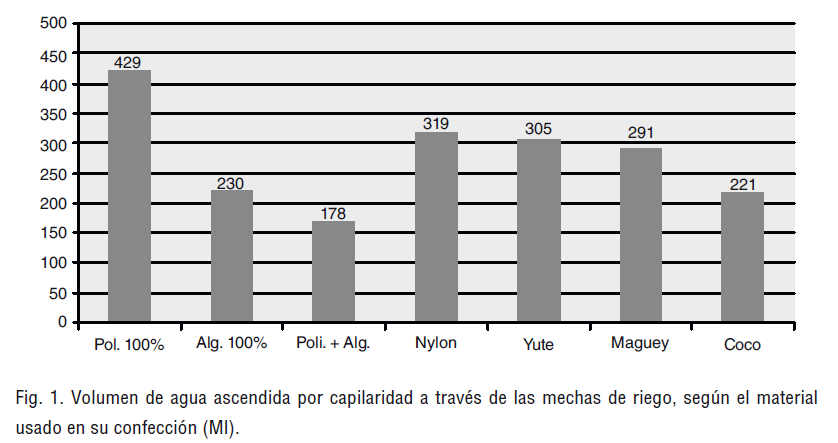
The watering for wick is a new technique that emerges among the existent technologies and it constitutes an efficient alternative in the propagation of the cultivations and the production of cultivations of short cycle; with the result that it becomes necessary to establish technological parameters, starting from the capillary ascension, for the selection of the most appropriate materials in the making of the originator. For it was developed it the experiment in the Estación Experimental Agroforestal Baracoa with the objective of determining the properties of capillary ascension in watering wicks made by materials of vegetable and synthetic origin. Substratum free type Fluvisol Gleyed was used in polyethylene bags (12 cm x 24 cm) under extreme conditions of humidity (7,5 %). The materials used were: Polyester 100 %, Polyester 65 % + Cotton 35 %, Nylon, Cotton 100 %, Jute, Maguey and Coconut. The height of visible humidity was evaluated in substratum and the ascended volume of water, both for wick type. The results, processed by Simple ANOVA with test from Duncan to 5%, showed significant statistical difference, when standing out in the capillary ascension the wicks of synthetic origin regarding those of vegetable origin.
Article Details

This work is licensed under a Creative Commons Attribution-NonCommercial 4.0 International License.
Those authors who have publications with this journal accept the following terms of the License Attribution-NonCommercial 4.0 International (CC BY-NC 4.0):
You are free to:
- Share — copy and redistribute the material in any medium or format
- Adapt — remix, transform, and build upon the material
The licensor cannot revoke these freedoms as long as you follow the license terms.
Under the following terms:
- Attribution — You must give appropriate credit, provide a link to the license, and indicate if changes were made. You may do so in any reasonable manner, but not in any way that suggests the licensor endorses you or your use.
- NonCommercial — You may not use the material for commercial purposes.
- No additional restrictions — You may not apply legal terms or technological measures that legally restrict others from doing anything the license permits.
The journal is not responsible for the opinions and concepts expressed in the works, they are the sole responsibility of the authors. The Editor, with the assistance of the Editorial Committee, reserves the right to suggest or request advisable or necessary modifications. They are accepted to publish original scientific papers, research results of interest that have not been published or sent to another journal for the same purpose.
The mention of trademarks of equipment, instruments or specific materials is for identification purposes, and there is no promotional commitment in relation to them, neither by the authors nor by the publisher.
How to Cite
References
CNUMAD: Enfoque del desarrollo sostenible. Comisión Mundial del Medio Ambiente y del Desarrollo. Naciones Unidas. 1987. García, R.; Dehogues, E. y L. Tzenova: El Riego. Ed. Pueblo y Educación, Ciudad de La Habana, Cuba. 447 pp., 1996.
Hernández, A.: Nueva versión de clasificación genética de los suelos de Cuba. Instituto de Suelos. La Habana: Instituto de Investigaciones de Suelo, Departamento de Geodesia. P. 46. 1994.
Microsoft® Encarta® [DVD]: Microsoft Corporation, 2008. “Capilaridad.” 2009.
Ochoa, P.: “Tecnología de riego por mecha como alternativa sostenible en la propagación del cacao por microinjertación en la región de Baracoa” [inédito], tesis de candidatura. Centro de Estudios Hidrotécnicos, Facultad de Ingeniería, Universidad de Ciego de Ávila, Cuba. 2013.
Ochoa, P.: El riego por mecha: una tecnología sostenible a favor de la seguridad alimentaria. Sitio WEB de la Representación de la FAO en Cuba. 2009.
Osorio, C.: Enfoques sobre la tecnología. Escuela de Ingeniería Industrial y Estadística de la Universidad del Valle de Colombia. 1997.
Panda, R.; Behera, S. and P. Kashyap: Effective management of irrigation water for maize under stressed conditions. Agricultural Water Management 3(66): 181-203, 2004.
Peña, M.; Vargas, P.; Dobaños, S. y J. González: Primer Informe Parcial. Proyecto de Investigación “Uso de Cápsulas y Potes Porosos para la Producción de Alimentos en Casas de Cultivo y Organopónicos de Agricultura Urbana”, código 13024. Centro de Estudios Hidrotécnicos, Facultad de Ingeniería, Universidad de Ciego de Ávila. 2002.
Vargas, P.; Peña, M. y D. De la Rosa: Desarrollo de la tecnología de riego por succión para la producción de vegetales a pequeña escala en Cuba. En: Ponencia al III Congreso Internacional de Riego y Drenaje. Hotel Meliá Habana. CUBA. 2007.
Vargas, P.: “Tecnología de riego por succión como alternativa sostenible para la producción de tomate” [inédito], tesis de candidatura. Centro de Estudios Hidrotécnicos. Facultad de Ingeniería. Universidad de Ciego de Ávila. 2009.