Test of three rehabilitation methods in established plantations of Theobroma cacao Lin. in Baracoa
Article Sidebar
Main Article Content
Abstract
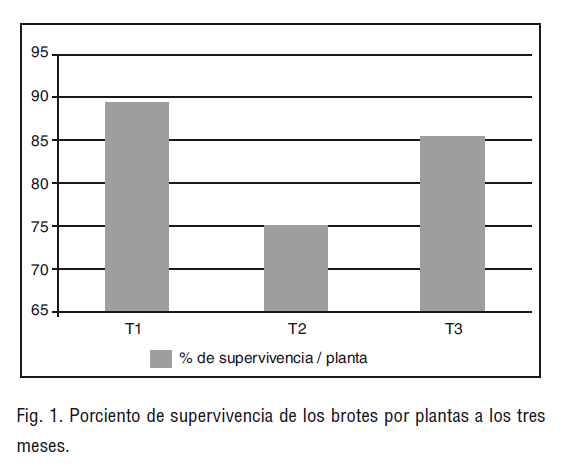
Starting from 1990 year the cocoa production began to descend due to diverse factors among those that we can mention: affectations for hurricanes, advanced age of the producers, depopulation, deficiency in the supply of necessary resources for the plantations management, technological indiscipline’s, etc.; however, exists in the territory a considerable quantity of areas that would elevate the yields of being rehabilitated in few years and they would bring economic improvements for the cacao-growers and its families and for the economy of the territory and of the country. With the purpose of increasing the yields of the cocoa, by means of the management of areas selected to rehabilitate, the experiment was developed in the Estación Experimental Agroforestal of Baracoa, three variants were studied to determine the best or the best methods of rehabilitation of established plantations: the total cut of the plant to 30 cm of the soil to select the offspring’s that will form the new plant (total back cutting) (T1); a son’s Induction by means of the sap suppression in the basal part of the trunk (T2); Renovation of the air part of the plant (T3). The results were processed by means of an analysis of variance of double classification and compared according to Duncan docima. Investigation is it allowed us to conclude with the determination of the best method to duplicate the yields the T3, because it was the best treatment and as for the precocity to the appearance of flowers and number of ears and as better method for the formation of a new tree the T1
Article Details

This work is licensed under a Creative Commons Attribution-NonCommercial 4.0 International License.
Those authors who have publications with this journal accept the following terms of the License Attribution-NonCommercial 4.0 International (CC BY-NC 4.0):
You are free to:
- Share — copy and redistribute the material in any medium or format
- Adapt — remix, transform, and build upon the material
The licensor cannot revoke these freedoms as long as you follow the license terms.
Under the following terms:
- Attribution — You must give appropriate credit, provide a link to the license, and indicate if changes were made. You may do so in any reasonable manner, but not in any way that suggests the licensor endorses you or your use.
- NonCommercial — You may not use the material for commercial purposes.
- No additional restrictions — You may not apply legal terms or technological measures that legally restrict others from doing anything the license permits.
The journal is not responsible for the opinions and concepts expressed in the works, they are the sole responsibility of the authors. The Editor, with the assistance of the Editorial Committee, reserves the right to suggest or request advisable or necessary modifications. They are accepted to publish original scientific papers, research results of interest that have not been published or sent to another journal for the same purpose.
The mention of trademarks of equipment, instruments or specific materials is for identification purposes, and there is no promotional commitment in relation to them, neither by the authors nor by the publisher.
How to Cite
References
Eskes, A.: Evaluation of vigour, yield and pod and bean traits. Working procedures and Recording Sheets for the CFC/ ICCO/IPGRI Project. Montpellier Cedex 5, France. 1999.
Grisales, A y G. Cubillos: Rehabilitación de poblaciones de cacao deterioradas por escoba de bruja mediante el método de renovación de la copa. El Cacaotero Colombiano. (31) Pp. 36-41,1985.
Meneses, A.: Efecto de la poda sobre el desarrollo y producción de los árboles de cacao (Theobroma cacao Lin.). Instituto Tecnológico de Costa Rica, San Carlos. 59 pp., 1988.
MINAG. Ministerio de la Agricultura: Instrucciones Técnicas para el Cultivo y Cosecha del Café y el Cacao: Dirección Nacional de Café y Cacao. CIDA. --La Habana. Pp.147208, 1987.
Nosti, J.: Cacao y Café. La Habana. Ed. Revolucionaria. —p. 172., 1962.
Paredes, M. y col.: Manual del cacao en Perú. — Perú, 46 Pp., 2003.
Rodríguez, Nilda, de S.: Manejo Integral del cultivo del cacao. Facultad de Agronomía de la Universidad Central de Venezuela. Instituto de Agronomia. 61 pp., 2001.