Evaluation of the genotypic stability of pre-commercial cuban cultivar of coffee (Coffea arabica L.) by means of the biplots representations
Article Sidebar
Main Article Content
Abstract
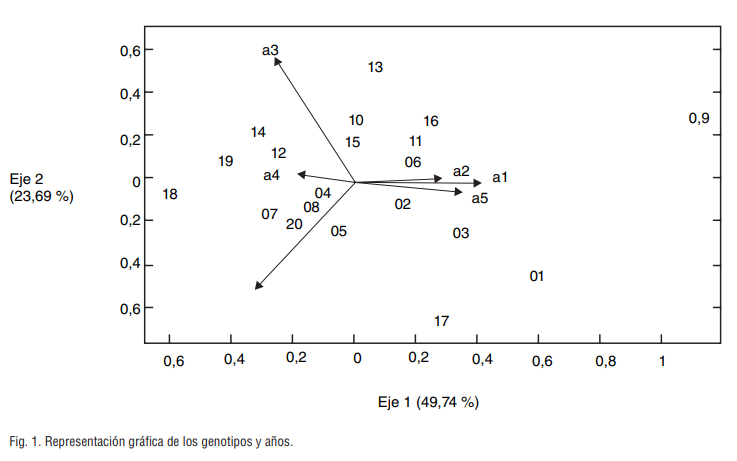
With the objective to estimating the genotypic stability in Cuban cultivars of coffee across of the employment of the Biplot method, in a typical town of the solid mountains of Guamuhaya, at 340 msnm an integrated rehearsal was developed by 18 materials and 2 witnesses (cv. Red Caturra and Villalobos). The coffees were planted at randomized blocks design with four replicates. The describer weight of the berries was evaluated by tree (kg–1) during six successive harvests. An analysis of genotype-ambient variance was used, where the effect of the replicates was eliminated in the atmospheres and it was adjusted a model of Effects Main Preservatives and Interaction Multiplicative (AMMI), consistent in adjusting a Biplot to the womb of residual of interaction of the Lineal Pattern. The cultivars CUBCC 0514, CUBCC 0522, CUBCC 0525 and CUBCC 0528 showed a phenotypical stability above the stocking, little interaction with the atmospheres and the stocking of the yield overcame to the other ones, for the conditions of a technology of low external inputs with agro ecological base. In turn it was showed the viability of the statistical method AMMI, since it allowed the estimate of the genotypic stability in materials of coffee in connection with the position to the origin of coordinated, the cultivars responsible for the significant interaction and the identification of the best with a view to their recommendation for the towns.
Article Details

This work is licensed under a Creative Commons Attribution-NonCommercial 4.0 International License.
Those authors who have publications with this journal accept the following terms of the License Attribution-NonCommercial 4.0 International (CC BY-NC 4.0):
You are free to:
- Share — copy and redistribute the material in any medium or format
- Adapt — remix, transform, and build upon the material
The licensor cannot revoke these freedoms as long as you follow the license terms.
Under the following terms:
- Attribution — You must give appropriate credit, provide a link to the license, and indicate if changes were made. You may do so in any reasonable manner, but not in any way that suggests the licensor endorses you or your use.
- NonCommercial — You may not use the material for commercial purposes.
- No additional restrictions — You may not apply legal terms or technological measures that legally restrict others from doing anything the license permits.
The journal is not responsible for the opinions and concepts expressed in the works, they are the sole responsibility of the authors. The Editor, with the assistance of the Editorial Committee, reserves the right to suggest or request advisable or necessary modifications. They are accepted to publish original scientific papers, research results of interest that have not been published or sent to another journal for the same purpose.
The mention of trademarks of equipment, instruments or specific materials is for identification purposes, and there is no promotional commitment in relation to them, neither by the authors nor by the publisher.
How to Cite
References
Amaro, R. I.: “Modelo anova-biplot para un diseño con varios factores basados en modelos lineales generales multivariantes” [inédito], tesis de candidatura. Universidad de Salamanca. España, 2001.
Análisis de la Estabilidad Genética, 2009 Disponible en: http://74.125.77.132/www.dspace.espol.ed [Consulta: agosto, 27 2009].
González, María Esther: Análisis de la estabilidad genotípica en el cultivo de la papa (Solanum tuberosum L.) mediante las representaciones Biplots. Cultivos Tropicales 24 (1): 8184, 2003.
Méndez, A. N. G.: “Avaliação de metodologias empregadas na seleção de progenies do cafeeiro /Coffea arabica/ L. no Estado de Minas Gerais” [inédito], tesis de candidatura. Lavras, MG (Brasil), Escola Superior de Agricultura de Lavras, 1994.
Varela, M.: “Los métodos Biplots como herramientas de análisis de interacción de orden superior en un Modelo Lineal/ Bilineal” [inédito], tesis de candidatura. Universidad de Salamanca, España, 2002.
Varela, M. y J. G. Castillo: Modelos con término multiplicativo. Aplicación en el análisis de la interacción genotipo ambiente, Cultivos Tropicales, 26 (3): 71-75, 2005.