Effect of water stress on the behavior of cultivars of Coffea arabica under in vitro conditions
Article Sidebar
Main Article Content
Abstract
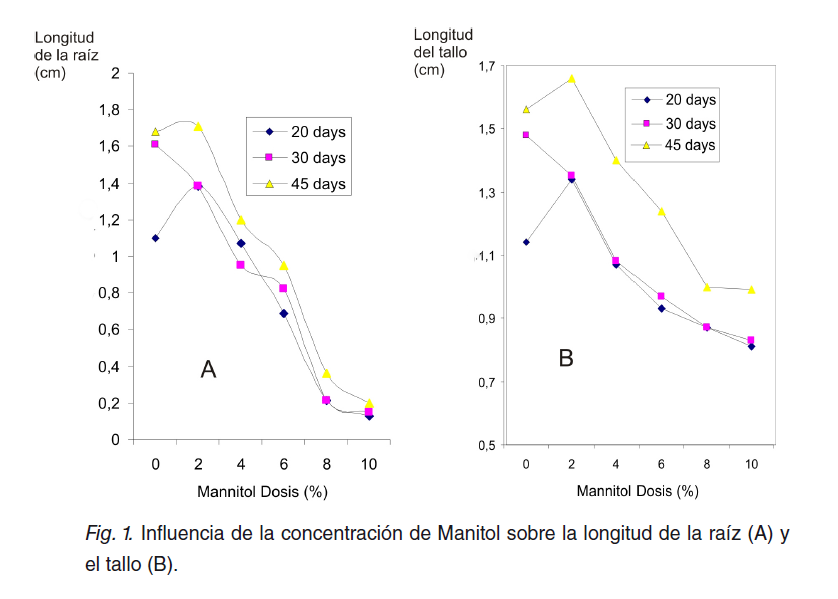
The investigation was developed in the biotechnology laboratory in the Centro de Investigaciones Agrícolas of Gima (Jimma Agricultural Research Centre), to the Southwest of Ethiopia; between January and October of the 2007 period; to value the effect of the osmotic stress (water stress) on the growth of the stalk and roots of four cultivars of Coffea arabica under cultivation conditions in vitro. Samples of mature seeds of four Coffea arabica cultivars were used (Aba Buna, F-59, 7487 and Gawe), taken place in the season from the 2006 to the 2007 and benefitted by Coffee Breeding department and Coffee Agronomy of JARC. The zygotic embryos were deposited on the basal means SH (Schenk and Hildebrandt, 1972), containing BAP (0.02 mg/L), ELL (0.02 mg/l) and GA3 (0.05 mg/L). Six concentrations of the Manitol osmotic agent’s (0, 2, 4, 6, 8 and 10 %) were used for each coffee genotype. A significant differences among the coffee germplasm subjected to the stress (p < 0.05) for the root longitude. The growth of the root of the four cultivars was significantly inhibited with the osmotic stress taken place by the use of the Manitol. However, a Manitol concentration to 2 % produced the stimulation in the elongation from the root to the 20 days and 45 days after the treatment. The lethal doses (DL) for the root growth were 6 % from Manitol to the 20 days and 6.5 % from Manitol to the 10 days and 45 days.
Article Details

This work is licensed under a Creative Commons Attribution-NonCommercial 4.0 International License.
Those authors who have publications with this journal accept the following terms of the License Attribution-NonCommercial 4.0 International (CC BY-NC 4.0):
You are free to:
- Share — copy and redistribute the material in any medium or format
- Adapt — remix, transform, and build upon the material
The licensor cannot revoke these freedoms as long as you follow the license terms.
Under the following terms:
- Attribution — You must give appropriate credit, provide a link to the license, and indicate if changes were made. You may do so in any reasonable manner, but not in any way that suggests the licensor endorses you or your use.
- NonCommercial — You may not use the material for commercial purposes.
- No additional restrictions — You may not apply legal terms or technological measures that legally restrict others from doing anything the license permits.
The journal is not responsible for the opinions and concepts expressed in the works, they are the sole responsibility of the authors. The Editor, with the assistance of the Editorial Committee, reserves the right to suggest or request advisable or necessary modifications. They are accepted to publish original scientific papers, research results of interest that have not been published or sent to another journal for the same purpose.
The mention of trademarks of equipment, instruments or specific materials is for identification purposes, and there is no promotional commitment in relation to them, neither by the authors nor by the publisher.
How to Cite
References
Bohnert, H. J.; Nelson, D. E. and R. G. Jensen: Adaptations to environmental Stresses. Plant Cell, 7:10991111, 1995.
Bradford, K. L. and T. C. Hsiao: Physiological responses to moderate water stress. In: Lange OL, Nobel PS, Osmond CB, Ziegler H (eds.). Encyclopedia of plant physiology (new series) 12B: Physiological plant ecology. II. Water relations and carbon assimilation Springer-Verlag, pp. 263–324, Berlin, 1982. Bray, E.A.: Molecular responses to water deficit. Plant Physiology. 103:1035-1040, 1993.
Coste, R.: Coffee. The plant and the product. Macmillan, London, pp. 285, 1992.
Jones, H. G. and J. E. Corlett: Current topics in drought physiology: Review. J Agric Sci., 119:291-296, 1992.
Ramos N., R.; Cabrera, Mireya; Chill, Idelsis; González, Ma. Esther; Mederos, Yunis; Díaz, A.; Pérez, A. y F. Martínez: Tecnología para la recuperación del agar a partir de los medios de cultivos de tejidos de desechos empleados en biotecnología vegetal. En: Programa, Conferencias y Resúmenes Simposio Internacional de Café y Cacao, p. 39, Teatro Heredia, Santiago de Cuba, 1999.
Salisbury, F. B. and C. W. Ross: Photosynthesis: Chloroplasts and Light. In: Plant Physiology. Wadsworth Publishing Company, pp. 214-218, 1992.
Schenk, R. U. and A. C. Hildebrandt: Medium and techniques for induction and growth of monocotyledonous and dicotyledonous plant cell cultures. Can. J. Bot. 50:199-204. 1972.
Taye, Kufa: Ecophysiological diversity of wild Arabica coffee populations in Ethiopia: Growth, water relations and hydraulic characteristics along a climatic gradient, Ecology and Development Series, No. 46, Cuvillier Verlag, 2006.
Tesfaye, Shimber: “Growth, water relation, yield and crop quality of Arabica coffee in response to water stress and deficit irrigation” [inédito], tesis de candidatura, University Putra Malaysia, 2006.
Wintgens, J. N.: Coffee: Growing, Processing, Sustainable Production. A guide for growers, traders, and researchers. WILEY-VCH Verlag GmbH and Co.KGaA, 115 pp., Weinheim, Germany, 2004.