Evaluation of the growth and the yield de Coffea canephora, Pierre ex Froehner in different densities of plantation cultivated under the conditions of the alcarraza in the mountainous solid Nipe Sagua Baracoa
Article Sidebar
Main Article Content
Abstract
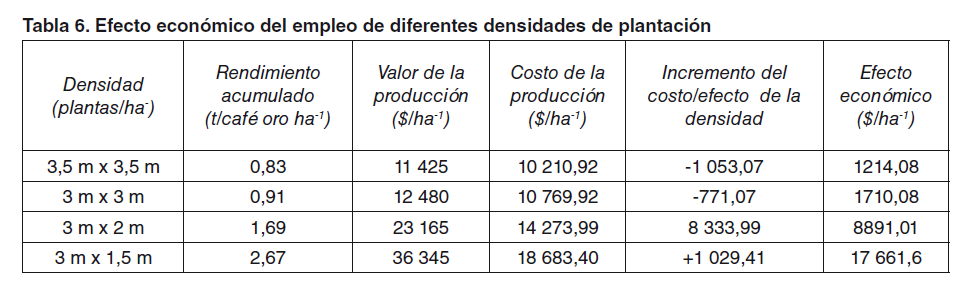
With the objective of determining the influence that it has more than enough some parameters of the growth and yield has the employment of different plantation densities in Coffea canephora, was developed an experiment in the area of investigations Scientist-Techniques of The Alcarraza, municipality Sagua de Tánamo, belonging to the Estación de Investigaciones de Café y Cacao of Velasco, Holguín province. The coffees were planted on a Brown gleyed soil without carbonates at 300 msnm and the parcels were prepared at randomized blocks design with four replicates. Four plantation distances were used: 3.5 m x 3.5 m; 3 m x 3 m; 3 m x 2 m and 3 m x 1.5 m that constituted the treatments. They were carried out evaluations of the height, diameter of the glass, diameter of the shaft and number of branches to the coffees and the yield of three crops was determined. To the obtained data was carried out a variance analysis of double classification and Duncan test of multiple ranges in the necessary cases. The variation of the plantation density didn’t cause a significant effect on the height of the coffees. The biggest values for the variable diameter of the glass, diameter of the shaft and number of productive branches were reached with the smallest spacing’s in the coffees. The increment of the plantation density produced a significant effect on the yield and it achieved an economic effect of $8770.59 per hectare for the distance of 3 m x 1.5 m.
Article Details

This work is licensed under a Creative Commons Attribution-NonCommercial 4.0 International License.
Those authors who have publications with this journal accept the following terms of the License Attribution-NonCommercial 4.0 International (CC BY-NC 4.0):
You are free to:
- Share — copy and redistribute the material in any medium or format
- Adapt — remix, transform, and build upon the material
The licensor cannot revoke these freedoms as long as you follow the license terms.
Under the following terms:
- Attribution — You must give appropriate credit, provide a link to the license, and indicate if changes were made. You may do so in any reasonable manner, but not in any way that suggests the licensor endorses you or your use.
- NonCommercial — You may not use the material for commercial purposes.
- No additional restrictions — You may not apply legal terms or technological measures that legally restrict others from doing anything the license permits.
The journal is not responsible for the opinions and concepts expressed in the works, they are the sole responsibility of the authors. The Editor, with the assistance of the Editorial Committee, reserves the right to suggest or request advisable or necessary modifications. They are accepted to publish original scientific papers, research results of interest that have not been published or sent to another journal for the same purpose.
The mention of trademarks of equipment, instruments or specific materials is for identification purposes, and there is no promotional commitment in relation to them, neither by the authors nor by the publisher.
How to Cite
References
Braga, A.; Papua, A.; Gantijo, P. T. y A. Pereira: Fisiología del cafeto en plantaciones densas. En: Simposio Internacional sobre café con altas densidades. IAPAR. Brasil, pp. 78-85, 1994.
Cabrera, M.; Catalina López; Maira Portilla y C. Bustamante: Descripción de clones de Coffea canephora en el Tercer Frente. Café Cacao, 1(1): 23-29,1998.
Cestac, Y. et J. Snoeck: Les essais de densité de dispositifs de plantation et de taille sur caféier Robusta en Cote D´Ivoire. Café Cacao Thé, 11 (4): 312-320, 1982.
Charrier, A. L.: Amelioration genetique des cafes. Le Recherche, 13 (136): 1006-1016, 1982.
Cortés, S.; Schoeic, O.; Simón, E. y T. Tejeda: Las altas densidades de plantación en el cafeto (Coffea arabica L. var. ‘Caturra’), su influencia sobre el rendimiento y sus componentes. Cultivos Tropicales, 17(2): 49-54,1996.
Deuss, J. y F. Descroix: Le bouturage du cafeier Robusta dans le progranme de realantation de la cafeier au Togo. Café Cacao Thé, 28(3):165-178, 1984.
Díaz, W., Molina, G.; Vázquez, E. y R. Reyes: Comportamiento morfológico y rendimientos en la primera cosecha de cafetos (Coffea canephora P.) plantados bajo cuatro densidades. Café Cacao, 3(3): 26-28,2002.
Grave de Peralta, G.; Díaz, W. y Maritza Rodríguez: Manejo de la poda y reducción gradual de los árboles de sombra en Coffea canephora. Café Cacao, 1(1): 36-41, 1998.
Gutiérrez, Z. G. y B. Soto: Diferentes métodos de poda y sus resultados. ANACAFE, 158:23, 1976.
Hernández, A. y col.: Nueva versión de la clasificación genética de los suelos de Cuba, 75 pp., Instituto de Suelos, La Habana, 1994.
López, C.; M. Cabrera; Silva, N. y otros: Algunos aspectos productivos de Coffea canephora Pierre ex Froehner. Revista Baracoa, 3(2):60-67, 1993.
Minag, Ministerio de la Agricultura, Cuba: Indicaciones para la siembra y el cultivo de café Robusta, 14 pp., Dir. Nac. de Café Cacao, Ministerio de la Agricultura, La Habana, 1989.
Ministerio de Finanzas y Precios, Cuba: Resolución 14, 6 pp., 2010.
Morales, D.: Influencia de dos distancias de plantación sobre el rendimiento y crecimiento de las plantas de Coffea arabica L. var ‘Caturra’ cultivada al sol. Ciencia y Técnica en la Agricultura, 2(1): 7-21,1990.
Nápoles, S.: Efecto de la densidad de plantación sobre algunos parámetros de crecimiento de Coffea arabica, var. Catuay a los dos años de plantada bajo sombra.
Ciencia y Técnica en la Agricultura, 7(1): 7-21, 1990.
Njoroge, J. M.; Warthaka, K. and J. A. Chaveya: The influence of tree training and plant desity on growth yield components and yield of arabica coffee cv. Ruim II. Journal of Horticultural Science, 67(5):695-702, 1992.
Ortíz, E.: Crecimiento y desarrollo del Coffea canephora Pierre ex Froehner, variedad Robusta con diferentes marcos de plantación. Cultivos Tropicales, 14(1): 4851, 1993.
Paulino, A. J.; Jabor, J. F. e J. B. Braganca: Espacaments para o cultivar Conilon no Estado Do Spiritu Santo. Resultados Preliminares. En: 9º Congresso Brassileiro de Pesquisas Caffeeiras, pp. 408-409, São Laurenco/M. Gerais, Brasil, 1981.
Soto, C. F.: Densidad de siembra de posturas de cafetos. Influencia sobre la altura de la planta, longitud de la raíz y el área foliar. Cultivos Tropicales, 8(3):39-42, 1991.
Srinivasan, C. S. A.: Comparative study of juvenile growth characters of Coffee varities in North East India. Resúmenes de Café, 15(20):10, 1990.
Uribe, H. A. y A. Mestre: Efecto de la distancia de siembra y el número de plantas por hoyo bajo la producción de café (Coffea arabica, L. var. Caturra). CENICAFE, 39(1): 15-27, 1988.
Verdecia. M., J.; Basulto, L. A.; Aldazabal R., M.; Viltres S., E. y F. Celeiro R.: Influencia de diferentes densidades de plantación sobre el rendimiento y algunos de sus componentes en el cultivo del cafeto (Coffea canephora, Pierre ex Froehner). Café Cacao, 3(3): 2425, 2002.