Behavior of the growth de Coffea canephora Pierre ex Frohener under low pruning system or back cutting
Article Sidebar
Main Article Content
Abstract
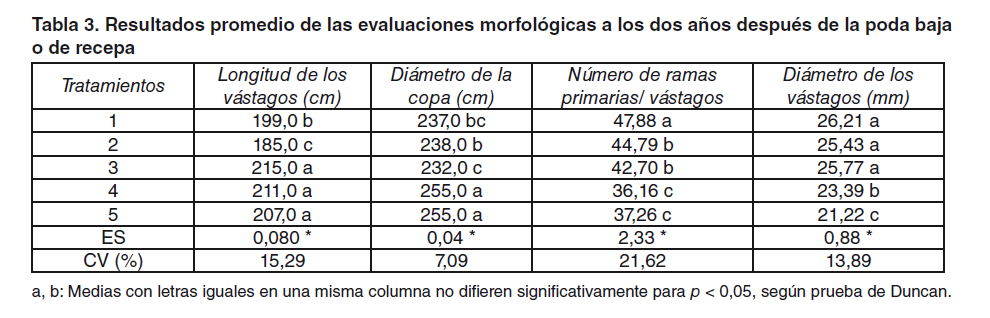
The investigation was developed during the understood period from 1996 to 2003. The experimental area was located in the town “Severiana”, located among the coordinated N: 167.00 and E: 509.00, in the Basic Unit of Agricultural Production (UBPC) “April 4”, belonging to the Coffee Company of the municipality Buey Arriba, Granma province. On a Brown Sialitic soil to 200 msnm and with pending drop, (6 %) low grove of pinenut florid Gliricidia sepium (Jacq) ex Kunth Walp. After the crop (February, 1996) it was applied low pruning or back cutting to the plantation, to 0.30 m of the surface of the soil and the treatments that consisted on leaving from three to seven offspring’s or head axes for plant settled down and one in which the low pruning was not applied which was left to free growth with reparation pruning (Witness). During two years the variables of growth: longitude of the offspring, diameter of the glass, number of offspring for plant and diameter of the offspring were evaluated. The statistical analysis carried out showed significant differences among the treatments for all the variables in study (except for the longitude of the offspring’s during the first year). We can conclude that to the two years the variable longitude of the offspring and diameter of the glass presented their best results in the treatments of more number of offspring for plant; while the variable number of offspring and diameter of these had better behavior in the treatments of smaller quantity of buds per plant.
Article Details

This work is licensed under a Creative Commons Attribution-NonCommercial 4.0 International License.
Those authors who have publications with this journal accept the following terms of the License Attribution-NonCommercial 4.0 International (CC BY-NC 4.0):
You are free to:
- Share — copy and redistribute the material in any medium or format
- Adapt — remix, transform, and build upon the material
The licensor cannot revoke these freedoms as long as you follow the license terms.
Under the following terms:
- Attribution — You must give appropriate credit, provide a link to the license, and indicate if changes were made. You may do so in any reasonable manner, but not in any way that suggests the licensor endorses you or your use.
- NonCommercial — You may not use the material for commercial purposes.
- No additional restrictions — You may not apply legal terms or technological measures that legally restrict others from doing anything the license permits.
The journal is not responsible for the opinions and concepts expressed in the works, they are the sole responsibility of the authors. The Editor, with the assistance of the Editorial Committee, reserves the right to suggest or request advisable or necessary modifications. They are accepted to publish original scientific papers, research results of interest that have not been published or sent to another journal for the same purpose.
The mention of trademarks of equipment, instruments or specific materials is for identification purposes, and there is no promotional commitment in relation to them, neither by the authors nor by the publisher.
How to Cite
References
Arcila, J. y B. Chávez: Desarrollo foliar del cafeto en tres densidades de siembra. Cenicafé, 46(1): 3-6, 2001.
Arias, L.; Mayra Aldazáabal; Verdecia, J., Viltres, E. y F. Celeiro: Comportamiento del rendimiento y algunos de sus componentes en el cultivo del cafeto Coffea canephora Pierre ex Froehner bajo diferentes ejes ortotrópicos. Café Cacao, 3(3): 21-22, 2002.
Braga, A.; Padua, A.; Gantijo, P. y A. Pereira: Fisiología del cafeto en plantaciones densas. En: Simposio Internacional sobre café con altas densidades, IAPAR (Brasil), 73-85 pp., 1994.
Carvajal, F.: Cafeto: cultivo y fertilización. Berna: Instituto Internacional de la Potasa, 121 pp., 1984.
Cortés, Sara; Estela Simón; Díaz, W.; Palomares, H. y A. Blanco: Nuevo manejo de la poda y la sombra del cafeto Coffea arabica L. en Cuba. Cultivos Tropicales, 15(2): 50-56, 1994.
Cumbá, Bárbara: “Manejo de la sombra y la poda en C. canephora P” [inédito], tesis de candidatura. Universidad de Guantánamo. 70 pp., 2002.
Díaz y col.: Establecimiento y manejo de Coffea canephora Pierre ex Froehner. En: Informe final de Proyecto Nacional Científico-Técnico. La Habana. 100 pp., 2003.
Farfán Valencia, F.: El zoqueo del café conserva el bosque nativo. Cenicafé, Avances Técnicos, (209), 1994.
Grave de Peralta, G.; Díaz, W. y Maritza Rodríguez: Manejo de la poda y la reducción gradual de los árboles de sombra en Coffea canephora P. Café Cacao, 1(1): 36-41, 1998.
Instituto de Suelos: Nueva versión de clasificación genética de los suelos de Cuba. Instituto de Suelos: Ministerio de la Agricultura. La Habana, 64 pp., 1999.
Matiello, J. B.: Café Conilon. Como plantar, tratar, colher, preparar e vender: Río de Janeiro: Procafé, 72-99, 1998.
Minag, Ministerio de la Agricultura, Cuba: Instrucciones Técnicas para el cultivo del café y el cacao. CIDA, La Habana, 208 pp., 1987.
Okelana, M. A. O.: Regeneración del cafeto Robusta, Coffea canephora P. Influencia de la altura de la copa y el número de brotes respecto al desarrollo vegetativo y la producción de cereza. Boletín de Promecafé, (19): 14. 1983.
Staver, Ch.: Un modelo para el manejo en parches de la superficie del suelo en café bajo sombra manejada. En: Resúmenes XVII Simposio de Caficultura Latinoamericana. Managua: Concafé. 1993.
Velasco, B. E.: “Efecto bioclimático del sombreo en áreas de Coffea arabica L. con alta densidad de plantación del macizo Sierra Maestra”, [inédito], tesis de candidatura. La Habana: INCA, MES, 2003.