Evaluation of the yields and the coffee production under edapho-climatic conditions of the Guisa Municipality
Article Sidebar
Main Article Content
Abstract
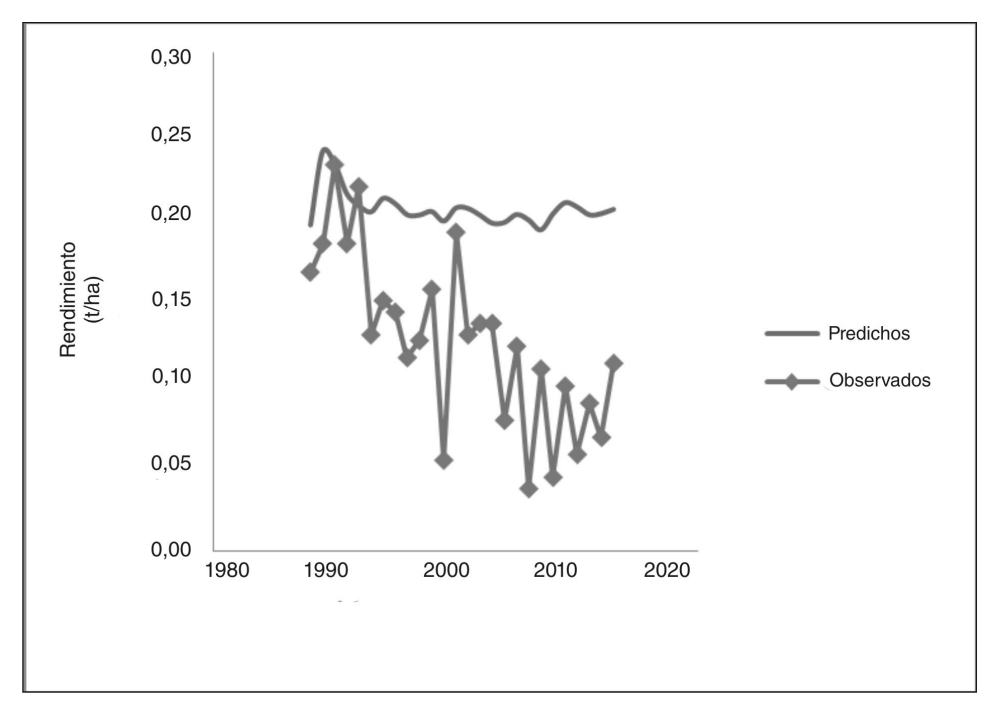
The work was developed in the Empresa Agropecuaria Batalla de Guisa, Granma in 1988-2013 period, with the objective of evaluating the yields and the coffee production in the edapho-climatic conditions of the Guisa municipality. A rising agro productive of the enterprise was carried out and were took information’s of the database related with the yields and production. For the processing of the information the statistical package InfoStat, 2001 was used, and to estimate the yield a multiple regression analysis was carried out where they were kept in mind as independent variables: the maximum temperature, the minimum temperature, the half temperature and the precipitations where it profited significant differences. The best results were reached in the five year period 1988- 1992, coinciding with the best behavior in the climatic factors. The productions were characterized by fluctuations with falling tendencies in the yields of 0,13 t • h-1 what represented 65 % less than the one obtained in the five year period (1988-1992) base, and for the areas in production of 3522,5 has that it represents 42,2 % less than the existent thing in the moment in that the municipality had the best productive results.
Article Details

This work is licensed under a Creative Commons Attribution-NonCommercial 4.0 International License.
Those authors who have publications with this journal accept the following terms of the License Attribution-NonCommercial 4.0 International (CC BY-NC 4.0):
You are free to:
- Share — copy and redistribute the material in any medium or format
- Adapt — remix, transform, and build upon the material
The licensor cannot revoke these freedoms as long as you follow the license terms.
Under the following terms:
- Attribution — You must give appropriate credit, provide a link to the license, and indicate if changes were made. You may do so in any reasonable manner, but not in any way that suggests the licensor endorses you or your use.
- NonCommercial — You may not use the material for commercial purposes.
- No additional restrictions — You may not apply legal terms or technological measures that legally restrict others from doing anything the license permits.
The journal is not responsible for the opinions and concepts expressed in the works, they are the sole responsibility of the authors. The Editor, with the assistance of the Editorial Committee, reserves the right to suggest or request advisable or necessary modifications. They are accepted to publish original scientific papers, research results of interest that have not been published or sent to another journal for the same purpose.
The mention of trademarks of equipment, instruments or specific materials is for identification purposes, and there is no promotional commitment in relation to them, neither by the authors nor by the publisher.
How to Cite
References
Acuña, R. J. y Mariol Morejón: La caficultura en Cuba: Evolución histórica y situación Actual. Café Cacao, 5 (1-2): 33-38, 2005.
Anzuelo, F.: Desarrollo de una variedad porta injertos resistentes a los principales nematodos de América Central. Boletín Promecafé, enero-junio: 13 – 15, 1995.
Basulto, L.; Aldazabal, M.; Verdecia, J. y E. Viltres: Comportamiento del rendimiento y algunos de sus componentes en el cultivo del cafeto (Coffea canephora Pierre ex Froehner) bajo diferentes ejes ortotrópicos. Café Cacao, 3 (3): 21-22, 2002.
CITMA: Variables climáticas del municipio de Guisa, Base de datos, Centro Meteorológico Provincial, 2014.
Coste, R.: El café. Editorial Blume. Barcelona, España. 254 pp., 1975.
Díaz, W. y col.: Instructivo Técnico Café Arábica. Instituto de Investigaciones Agro-Forestales – MINAGRI: Dirección de Café y Cacao del Grupo Empresarial. La Habana. 137 pp., 2013.
______: Instructivo Técnico Café Robusta. Instituto de Investigaciones Agro-Forestales - MINAGRI: Dirección de Café y Cacao del Grupo Empresarial. La Habana. 71 pp., 2013.
Grave de Peralta, G.; Caro, P. y M. Rodríguez: Evaluación de los índices del crecimiento y de producción en injertos de café plantados a diferentes densidades en un suelo con nematodos y valoración de una Finca de Referencia. Café Cacao, 3 (3): 19-20, 2002.
Gutiérrez, G. H. y G. Fernández: Apuntes históricos del café en Cuba, En: Documento inédito de la Dirección Nacional de Café y Cacao, MINAG, pp. 7 – 9, 1984.
Hernández, G: IV Clasificación Genética de los Suelos de Cuba. Instituto de Suelo. MINAG. Editorial Agrinfor. La Habana. 78 pp., 1999.
InfoStat: InfoStat. Versión 1.0 Universidad Nacional de Córdova, Argentina, 2001. Matiello, J. B.: Factores que afectan la productividad del café en Brasil. Associação Brasileira da Potasa e do Fosfato. Brasil. 212 pp., 1986.
Molina, G.; Díaz, W.; Vázquez, E. y R. Reyes: Rendimientos de cafetos (Coffea canephora Pierre ex Froehner) conducidos bajo diferente número de vástagos. Café Cacao, 3 (3): 30-31, 2002.
_____: Comportamiento de los rendimientos de cafetos Coffea canephora Pierre ex Froehner sometidos a poda de recepa y manejo intensivo de sombra. Café Cacao 7(2): 16-21, 2006.
Reyna, E. H: Técnica del injerto hipocotiledonar del café para el control de nematodos. Café Perú 7(1): 5-11,1968.
Rodríguez, M. I.; Grave de Peralta, G.; Fernández, I. y S. Castillo: Influencia de la poda y la regulación de sombra sobre el crecimiento y los rendimientos de Coffea arabica. Café Cacao 1(2): 26-29, 1998.
Verdecia J.; Arias, L.; Aldazábal, M.; Viltres, E. y F. Celeiro: Influencia de diferentes densidades de plantación sobre el rendimiento y algunos de sus componentes en el cultivo del cafeto (Coffea canephora Pierre ex Froehner). Café Cacao 3 (3): 24-25, 2002