Implementation of a training program for coffee producers in the Integral Forest Enterprise Mayarí
Article Sidebar
Main Article Content
Abstract
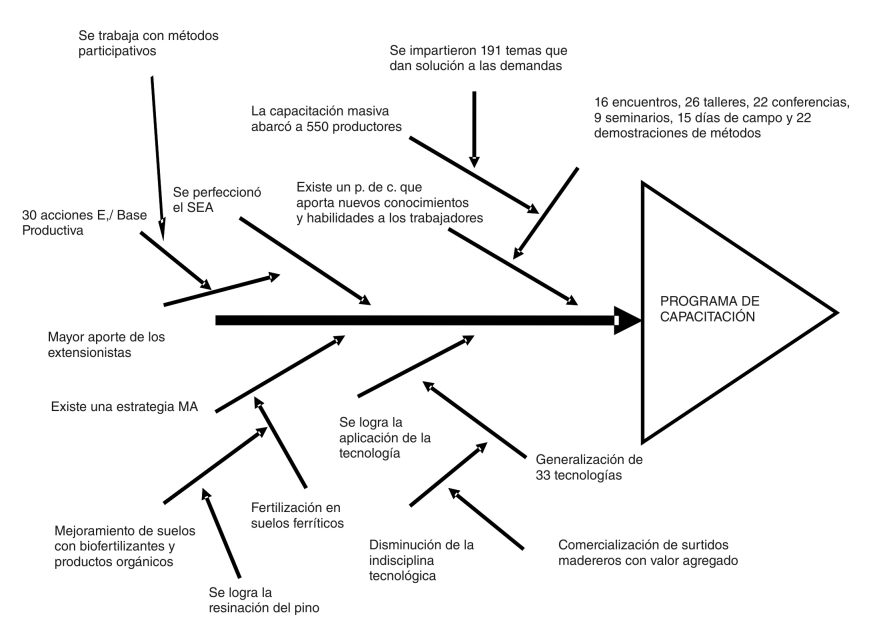
The investigation was developed in the Integral Forest Enterprise Mayarí and it consisted on the linking of the technicians and investigators of the Estación Experimental Agro[1]Forestal Tercer Frente and those producers of this enterprise by means of a Training Program. The program was developed from November/2009 to June/2015 chord to the occupational categories in demands function of the producers, several topics were developed in function of the application of technologies and results of those investigations. The initial situation was diagnosed, being proven: Insufficient application of the science and the technique, high incidence of technological indiscipline’s, nonexistence of a Strategy Half Environmental and insufficient protagonist roll of the extensions’. 14 encounters were carried out, in those that 26 workshops, 22 conferences, 9 seminars, 15 days of field and 22 demonstrations of methods were developed. It was achieved the direct training of 550 people and the extensions’ guaranteed the generalization of the knowledge and experiences to the rest of the linked workers of the enterprise. As main result stands out the existence of a Program of Training that contributed elements for the improvement of the System of Agrarian Extension, the implementation of a Half Environmental Strategy, with a bigger contribution of the extensions’ in the application of the technologies, the rescue of the technological discipline and the generalization and application of 33 technologies, being the interactive activities those of more acceptance for the producers. In the properties where you monitory the productive behavior the yields were increased with a rising favorable economic effect to the producer.
Article Details

This work is licensed under a Creative Commons Attribution-NonCommercial 4.0 International License.
Those authors who have publications with this journal accept the following terms of the License Attribution-NonCommercial 4.0 International (CC BY-NC 4.0):
You are free to:
- Share — copy and redistribute the material in any medium or format
- Adapt — remix, transform, and build upon the material
The licensor cannot revoke these freedoms as long as you follow the license terms.
Under the following terms:
- Attribution — You must give appropriate credit, provide a link to the license, and indicate if changes were made. You may do so in any reasonable manner, but not in any way that suggests the licensor endorses you or your use.
- NonCommercial — You may not use the material for commercial purposes.
- No additional restrictions — You may not apply legal terms or technological measures that legally restrict others from doing anything the license permits.
The journal is not responsible for the opinions and concepts expressed in the works, they are the sole responsibility of the authors. The Editor, with the assistance of the Editorial Committee, reserves the right to suggest or request advisable or necessary modifications. They are accepted to publish original scientific papers, research results of interest that have not been published or sent to another journal for the same purpose.
The mention of trademarks of equipment, instruments or specific materials is for identification purposes, and there is no promotional commitment in relation to them, neither by the authors nor by the publisher.
How to Cite
References
Minag, Ministerio de la Agricultura: Estación Central de In vestigaciones de Café y Cacao. Tercer Frente, Santiago de Cuba, Libro Registro de Logros del Centro, 15 pp., 2007.
Monzote, Martha y F. Funes: Agricultura y educación ambiental. Primera conversación Internacional sobre Medio Ambiente y Desarrollo. EN: Memorias del 3.er Congreso de educación ambiental para el desarrollo sostenible, La Habana, 1997.
Rodríguez, J., Bertha Ramírez y A. Guayara: Diagnóstico y planificación de la finca soñada: participación comu nitaria por el cambio. LEISA revista de Agroecología, 22(1):13-18, 2006.
TQM. Manager: «Análisis de Pareto», 5 pp., Disponible en: http://www.nanart.com.ar/, 2001a.
TQM. Manager: «Diagrama de Causa y Efecto», 5 pp., Disponible en: http://www.nanart.com.ar/, 2001b.
Zayas A., P. M.: El rombo investigativo. Un método lógico práctico para la concepción, proyección y ejecución de investigaciones, 79 pp., Editorial Academia, La Habana, 1997.