Integrated management influence of Colletotrichum gloeosporioides on the reduction of toxic loads in the coffee, Guisa municipality
Article Sidebar
Main Article Content
Abstract
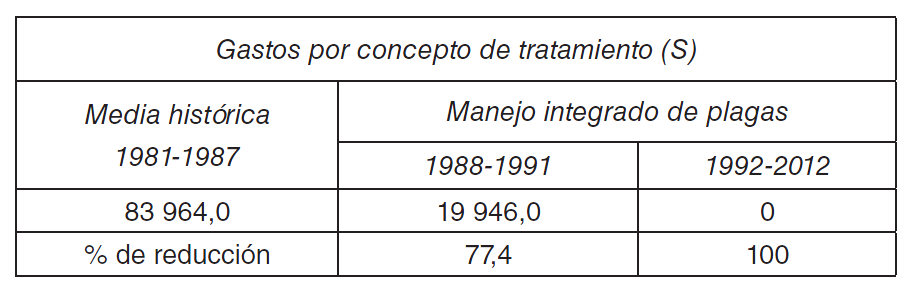
The work was developed in coffee areas of the municipality of Guisa, Granma province, in the period framed among 1981-2012. In the same one was carried out an evaluation of the effect of the integrated management of plagues on the reduction of the percent of infection of Colletotrichum gloeosporioides (Penz.) Sacc. in the coffee cultivation of 13 coffee areas of the municipality according to signaling and presage methodology of the CNSV (1980). An analysis of the behavior of this pathogen is shown before the implementation of this technique (1984-1987) and after its application (1988-2012). This noxious organism stayed in very low levels since 1992. The toxic loads were evaluated starting from 1981, showing a significant reduction beginning after the implementation of the integrated management, reaching zero percent of toxic loads in 1992. It was realized an economic analysis taking as indicators seven years before (1981-1987) and twenty five years after of its application. Reaching a saving of 1 931 172.00 pesos.
Article Details

This work is licensed under a Creative Commons Attribution-NonCommercial 4.0 International License.
Those authors who have publications with this journal accept the following terms of the License Attribution-NonCommercial 4.0 International (CC BY-NC 4.0):
You are free to:
- Share — copy and redistribute the material in any medium or format
- Adapt — remix, transform, and build upon the material
The licensor cannot revoke these freedoms as long as you follow the license terms.
Under the following terms:
- Attribution — You must give appropriate credit, provide a link to the license, and indicate if changes were made. You may do so in any reasonable manner, but not in any way that suggests the licensor endorses you or your use.
- NonCommercial — You may not use the material for commercial purposes.
- No additional restrictions — You may not apply legal terms or technological measures that legally restrict others from doing anything the license permits.
The journal is not responsible for the opinions and concepts expressed in the works, they are the sole responsibility of the authors. The Editor, with the assistance of the Editorial Committee, reserves the right to suggest or request advisable or necessary modifications. They are accepted to publish original scientific papers, research results of interest that have not been published or sent to another journal for the same purpose.
The mention of trademarks of equipment, instruments or specific materials is for identification purposes, and there is no promotional commitment in relation to them, neither by the authors nor by the publisher.
How to Cite
References
Benítez, G. D.: Tecnologías para la producción sostenible en ecosistemas frágiles y degradados. Grupo de Investigaciones de la Estación Experimental de Pastos y Forrajes La Pitucha. 139 – 143 pp., 2010.
CIBA – GEICY: Metodología costo-beneficio. 15 Pp., 1981. CNSV: Manual de Plaguicida de la República de Cuba. Ministerio de la Agricultura. Centro Nacional de Sanidad Vegetal. La Habana. 396 Pp., 1980, 1984, 1988,1992, 1996, 1998.
CNSV: Manual para la realización de los RTH. Ministerio de la Agricultura. Centro Nacional de Sanidad Vegetal. La Habana. 341 Pp., 1980. La Prensa: Mercado Mundial de Café Seguirá Fuerte. Disponible en: http://www.laprensa.com.ni/archivo/2008/abril/19/noticias/economia/254747.shtml [Consulta: noviembre 11, 2008].
Martínez, G. E.: Manejo Integrado de Plagas. Manual Práctico. Centro Nacional de Sanidad Vegetal (CNSV). Cuba. 526 Pp., 2007.
Murguido, C y E. Konnorova: Metodología para la señalización y el pronóstico de organismo nocivos en el cultivo del café. CNSV. 22 Pp., 1981.
ONE (Oficina Nacional de Estadística): Anuario Estadístico. La Habana. Cuba. 27 Pp., 2010.
Ortolegui, T. S.: Manejo Integrado de Plagas en Café. Guía Técnica. JAEM- Cajamarca/Bagua Grande-Amazonas. Perú. 29 Pp., 2012.
Silke- Beker. Sistema Cofeea spp y Hemileia vastatrix. En: La roya del cafeto. Conocimiento y control. Deutshe Geselschat fur Tecnische Zusammenarbeit (GTZ. Eschborn, 281 Pp., 1991.