Promotion of the Canavalia ensiformis L. growth by co-inoculation of Rhizobium strains and mycorrhizal fungi in brown soil without carbonates
Article Sidebar
Main Article Content
Abstract
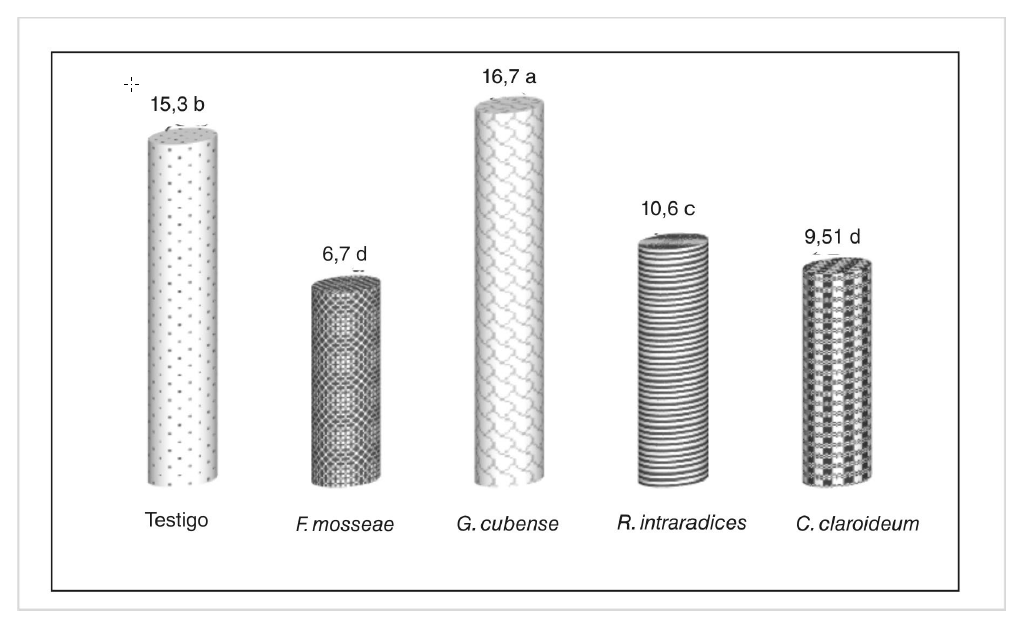
One of the alternatives for the requirements reinstatement of coffee in nitrogenous is the use of Canavalia ensiformis L. as what is of importance the increment of their biomass. In a randomized blocks factorial design was studied the effect of 4 Rhizobium strains and 5 strain of mycorrhizal fungi on to the growth of Canavalia indicators.The Rhizobium strain used were Can 2003a, Can 2003b, Can 3 and Can 5 with a title of 108-109 UFC. As EcoMic strains were used: G. cubense, F. moseae, R. intraradices y C. claroideum each one with 20 spores’ • gram-1 of inoculum. The height, leaves number, nodules number and the fresh and dry mass of the plants were evaluated. Data were processed using a factorial variance analysis and halves were compared by the Duncan docima. Strain Can 2003b increased the dry mass significantly and it was superior to the rest of the strains of Rhizobium. Among the HMA strains, G. cubense like was superior and it showed a efficiency index that oscillated between 9 % and 91,5 %.The biggest increments of dry mass were achieved with the combination Can 5-G. cubense. With the Rhizobium Can 2003b and the different strains of HMA were obtained a second treatments group as alternative. Native strain of HMA showed positive results with Rhizobium Can 2003b and Can 2003 strains. A depressive effect of the dry mass was observed from the Canavalia when using Can 2003a independently of the strain of HMA inoculated.
Article Details

This work is licensed under a Creative Commons Attribution-NonCommercial 4.0 International License.
Those authors who have publications with this journal accept the following terms of the License Attribution-NonCommercial 4.0 International (CC BY-NC 4.0):
You are free to:
- Share — copy and redistribute the material in any medium or format
- Adapt — remix, transform, and build upon the material
The licensor cannot revoke these freedoms as long as you follow the license terms.
Under the following terms:
- Attribution — You must give appropriate credit, provide a link to the license, and indicate if changes were made. You may do so in any reasonable manner, but not in any way that suggests the licensor endorses you or your use.
- NonCommercial — You may not use the material for commercial purposes.
- No additional restrictions — You may not apply legal terms or technological measures that legally restrict others from doing anything the license permits.
The journal is not responsible for the opinions and concepts expressed in the works, they are the sole responsibility of the authors. The Editor, with the assistance of the Editorial Committee, reserves the right to suggest or request advisable or necessary modifications. They are accepted to publish original scientific papers, research results of interest that have not been published or sent to another journal for the same purpose.
The mention of trademarks of equipment, instruments or specific materials is for identification purposes, and there is no promotional commitment in relation to them, neither by the authors nor by the publisher.
How to Cite
References
Bustamante, C.; Pérez-Díaz, A.; Viñals, R.; Rivera, R.; Pérez, Guianeya y M. Rodríguez: Efecto de la inoculación con cepas de Rhizobum sobre Indicadores de crecimiento y producción de biomasa por Canavalia ensiformis L. intercalada con cafeto en suelo Pardo de Cuba. En: Resúmenes XXIV Reunión Latinoamericana de Rhizobiología y I Conferencia Iberoamericana de Interacciones Microorganismo-Planta-Ambiente. La Habana. ISBN 978-959-16-1030-0, 2009.
Candanedo Lay, E; Aranda, G. y S. A. de Millán: Efecto de los exudados radiculares de Canavalia sp. en la patogénesis de Meloidogyne incognita, raza 2, en tomate. En: Quinta jornada agropecuaria región oriental. 5. Jornada Agropecuaria Región Oriental. Panamá (Panamá). 25 agosto 1994.
García, Margarita: “Contribución al estudio y utilización de los abonos verdes en cultivos económicos desarrollados sobre un suelo Ferralítico rojo de la Habana” [inédito], tesis de candidatura, Instituto de Ciencias Agrícolas (INCA), La Habana, 1997.
Gómez, E. J.; Padilla, R.; López, R.; Zamora, A. y R. Santiesteban: Efecto de la coinoculación rhizobium –micorriza en frijol Caupí (Vigna unguiculata l.) Var. It 86 d-715, en un suelo fluvisol de la provincia Granma. En: Resúmenes XXIV Reunión Latinoamericana de Rhizobiología y I Conferencia Iberoamericana de Interacciones Microorganismo- Planta- Ambiente. La Habana. ISBN 978-959-16-1030-0, 2009.
Martín, G.; Rivera, R. y L. Arias: Respuesta de la Canavalia ensiformis a la inoculación con Glomus hoi like en suelos con diferente contenido de esporas de hongos micorrizógenos arbusculares (HMA). En: Resúmenes XXIV Reunión Latinoamericana de Rhizobiología y I Conferencia Iberoamericana de Interacciones Microorganismo- Planta-Ambiente. La Habana. ISBN 978-959-16-1030-0, 2009.
Rivera, R.; González, P.J.; Hernández-Jiménez, A. y col.: La importancia del ambiente edáfico y del pH sobre la efectividad y la recomendación de cepas eficientes de HMA para la inoculación de los cultivos. En: VIII Congreso de la Sociedad Cubana de la Ciencia del Suelo, del 2 al 5 de Junio. La Habana, Cuba, ISBN: 978-959-296- 039-8, 2015.
Siqueira, J. O. y A. A. Franco: Biotecnologia do solo. Fundamentos e Perspectiva. MEC-ESAL-FAEPE-ABEAS. Brasilia, D.F. 235 Pp., 1988.
Terry, E. y J. Ruiz: Uso y manejo de Azotobacter sp. y hongos micorrizógenos inoculados a diferentes cultivos hortícolas. En: Resúmenes XXIV Reunión Latinoamericana de Rhizobiología y I Conferencia Iberoamericana de Interacciones Microorganismo- Planta- Ambiente. La Habana. ISBN 978-959-16-1030-0, 2009.
Torres Navarro, J. C. y M. J. Echeverry López: Efecto del intercalamiento de Canavalia ensiformis sobre el desarrollo vegetativo y primera cosecha de cafetos de seis meses de edad, zocas y nuevas siembras. Ceni- café, 39(3): 63-81, 1988.